Research hero

Research

Discover more about research and development projects in the world of Modern Methods of Construction (MMC) led by Irish higher education institutions and other research-performing organisations, alongside a showcase of research activity across the country, highlighting what is being done to drive new innovation and workforce development in Irish construction.
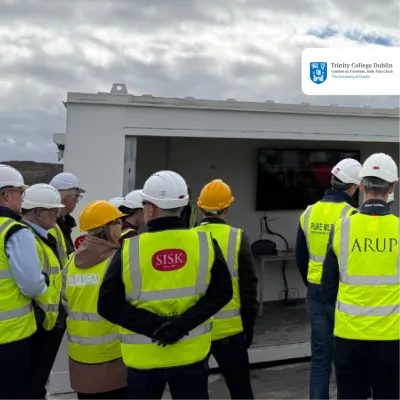

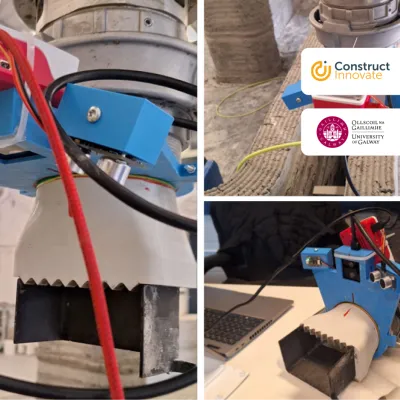
Researching and Developing the Right Concrete Products and Application Systems for 3D Construction Printing

3D construction printing is still in its earliest phase in Irish building, but research into the best-practice materials and applications of this type of Modern Method of Construction (MMC) can help increase the rate of uptake. Two researchers from the Construct Innovate unit of the University of Galway are making this happen. 
Industrial blue mechanical clamp or gripper tool shown in multiple close-up views on a workbench.
Platform4MMC: Supporting Decision-Making to Drive the Adoption of Modern Methods of Construction in Ireland

Ireland’s housing targets need to be met rapidly while achieving high sustainability standards. Modern Methods of Construction (MMC) offer the opportunity to digitise the construction sector, improving project delivery speed, efficiency, and quality. 
Logo for Platform MMC featuring stacked layers graphic in gray and dark tones.
Taking MMC Research to the Construction Site and Beyond

The MMC Research Group at University College Dublin (UCD), spearheaded by Dr Daniel McCrum, is leading the innovations behind Modern Methods of Construction (MMC).  

Professional headshot of a young man in a navy blazer and white shirt, smiling in an office setting.

Research showcase

  • Elsevier journal article graphic: "Adaptive Non-Invasive Quality Control in 3D Concrete Printing via Latency-Resilient Sensor Fusion."
    Jul 2026

    Adaptive Non-Invasive Quality Control in 3D Concrete Printing via Latency-Resilient Sensor Fusion

    Dr Pouyan Ghabezi, Dr Alireza Rahimi (University of Galway) & Jandré Oosthuizen, Justin Kinsella (Harcourt Technologies)
    Reliable geometric monitoring in three-dimensional concrete printing (3DCP) is limited by dust, variable lighting, surface wetness, and latency-induced inconsistencies across sensing modalities. This work develops a latency-resilient fusion framework using heterogeneous non-contact distance measurements including depth imaging, time-of-flight ranging, and ultrasonic echo sensing, to reconstruct nozzle-surface distance (NSD) in real time. The results highlight the robustness of multi-modal sensor fusion for real-time NSD estimation and establish a viable pathway toward adaptive, feedback-enabled automation in 3DCP.
    View Report on sciencedirectassets.com
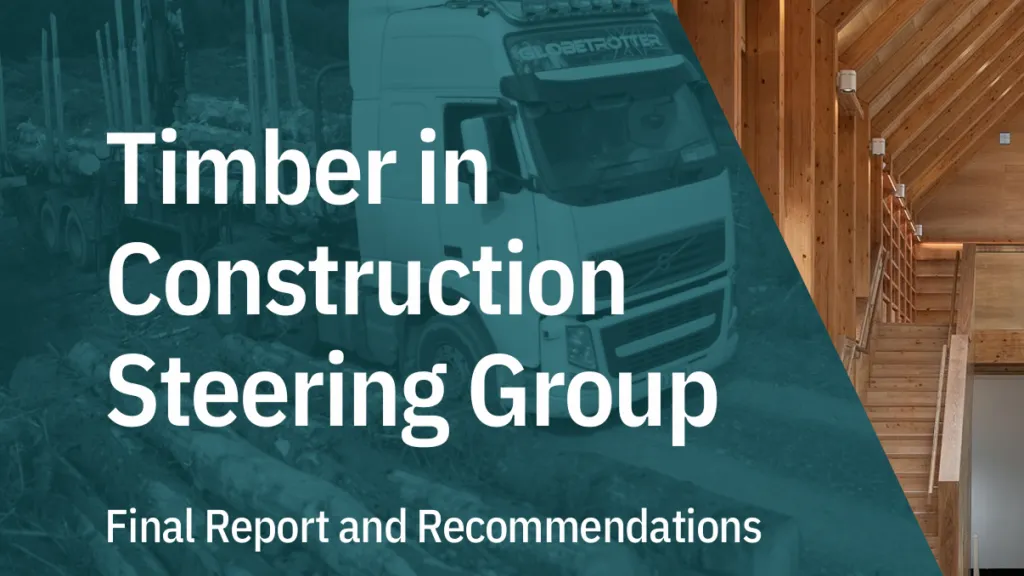
  • Graphic: "Timber in Construction Steering Group – Final Report and Recommendations" cover with timber staircase.
    Jun 2026

    Timber in Construction Steering Group – Final Report and Recommendations

    Interdepartmental & Industry Steering Group on Timber in Construction
    The Steering Group has developed a set of measures in this document to accelerate the safe use of timber in construction in a coherent roadmap focused on: education and research underpinning safe regulation; regulation and procurement creating market demand; data and incentives enabling monitoring and uptake; and public leadership to build confidence and drive industry innovation.
    View Report on gov.ie
  • Two construction workers reviewing plastering work, with "The Plastering Trade in Ireland" report cover graphic.
    Apr 2026

    The Plastering Trade in Ireland – Demand, Supply, and Future Skills Needs

    South East Regional Skills Forum, on behalf of the Department of Further and Higher Education, Research, Innovation and Science
    This report presents a comprehensive analysis of the plastering trade in Ireland augmented by detailed analysis form the South East region. The study explores both current and future dynamics within the sector, with a particular focus on understanding the balance between labour demand and the available supply of skilled plasterers.
    View Report on gov.ie
  • Construct Innovate logo with text: "Alternative Irish-based materials suitable as cementitious binders"
    Apr 2026

    Alternative Irish-Based Materials Suitable as Cementitious Binders

    Dr Niall Holmes (Technological University Dublin)
    Developing alternative cements goes beyond environmental concerns; it also has economic and strategic dimensions. Innovation in binder technology could position the Irish cement sector at the forefront of sustainable material export markets and reduce reliance on imported cementitious products. This research underscores a gap in identifying new locally available or engineered alternatives that can sustain and expand low-carbon cement production in Ireland.
    View Report on constructinnovate.ie
  • Cover of a report titled “TimberFlow: Enhancing Efficiency in Mass Timber Construction through Innovative Design Practices and Capacity Building”, by Construct Innovate – Built Environment Research Ireland.
    Apr 2026

    TimberFlow – Enhancing Efficiency in Mass Timber Construction through Innovative Design Practices and Capacity Building

    Dr. Muhammad Gulzari (University College Dublin)
    This report outlines the development of an open-source software tool designed to make mass timber construction more efficient and accessible in Ireland. The main finding of the report is that while timber is a sustainable and high-performing alternative to concrete and steel, its use in Ireland is limited by the complexity of structural design rules. To solve this, the team created the TimberFlow tool using the Python programming language.
    View Report on constructinnovate.ie
  • Sisk logo graphic on red background with text: "How much does span really cost in carbon?"
    Mar 2026

    SISK Slab Carbon Matrix Research

    SISK
    This research analyses the embodied carbon performance of multiple slab systems used in office buildings, testing how they behave across increasing grid sizes and comparing them under identical layout conditions.
    View Report on sisk.com