Translating R&D on Innovative Building Materials from the Lab to Real Application in Construction
Concrete production is one of the more carbon-intensive construction activities. But researchers from Trinity College Dublin are working to showcase that a lower-carbon concrete, produced with biomass ash, offers building companies a commercially viable and equally appliable alternative. How can research and development lead theory to practice and contribute to a more sustainable construction sector?
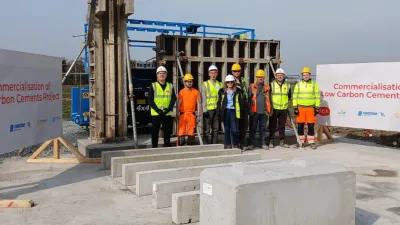
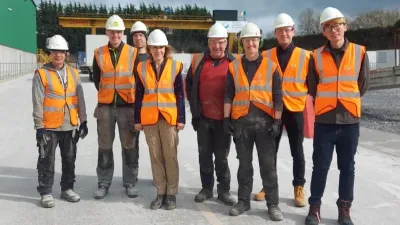 From left: Ariel Penaflor, Kieran Kelly, Arturs Kulikauskis, Sara Pavia, Ger Kirwan, David McDonnell, Luke O’Connor, Zehao Lei
Data from the Environmental Protection Agency shows people in Ireland produce 14+ million tonnes of waste every year. Much of this waste is biomass generated from organic sources such as forestry debris, food waste, and sewage. There are limited options for problem-free disposal, with burning waste as fuel producing biomass ash which then has to be landfilled. But what if there was an option for reusing this ash in a meaningful way?
Researchers from Trinity College Dublin’s School of Engineering completed a project showcasing biomass ash as the basis of both blended and cement‑free binders to produce low carbon concretes. The research project is led by Professor Sara Pavia and Dr Zehao Lei from Trinity through a 20‑month programme funded by Enterprise Ireland.
This work supports the ambitions set out in Trinity’s Sustainability Strategy 2023-2030, which calls for practical, research‑driven solutions that cut emissions, promote circular resource use, and influence sustainable practices in Ireland. It also opens the door for the building sector to embrace product-led innovation and develop in-house skills in research and development (R&D), to keep at the cutting-edge of construction practices globally.
For Professor Sara Pavia, this project is the culmination of more than 30 years of research into alternative materials for concrete production:
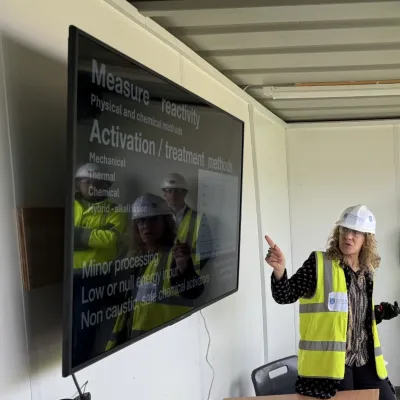
“My doctoral thesis looked at pozzolanic materials such as crushed ceramics and slags which I later applied to hemp concretes. After moving to Ireland, I did my post-doctoral research at Trinity College Dublin and the Dublin Institute of Technology, before returning to Trinity to lecture in civil engineering. Since 2002, I have focused on supplementary cementitious materials and non-clinker geopolymer cements made with waste materials to lower the carbon output of construction activities.”
Researcher at Trinity College Dublin
For Dr Zehao, the path to this research into geopolymer concrete was similar:
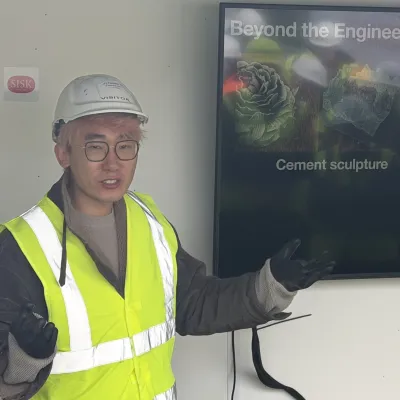
“I completed postgraduate study in China, testing high-performance, fibre-reinforced concrete. I had the opportunity to complete my PhD with Professor Sara at Trinity, and knew the focus in Ireland is on producing lower-carbon concrete rather than the reinforced concrete I was researching, so I pivoted my research.”
Researcher at Trinity College Dublin
In recent years, the researchers have discovered that biomass ash, sourced from Bord na Móna, has potential to partially replace Portland cements (PC) in PC-based materials, and to produce geopolymer (non-clinker) cement. Biomass ash geopolymers can be adapted to suit different setting times, lifespans, and strengths. This flexibility while lowering carbon output in production was key to translating the research into a range of applications.
“After discovering that biomass ash was suitable to produce geopolymer concrete, our focus has become about demonstrating that it is also commercially viable.”
Researcher at Trinity College Dublin
This latter point is crucial. Professor Sara points to major gaps in the use of lower-carbon cement in construction projects globally: “there are a lot of papers and not a lot of application”. Professor Sara and Dr Zehao were proactive in securing partnerships with precast producers to show the effectiveness, in real-world conditions, of their geopolymer concrete, some offering a 70% lower carbon output when compared to regular concrete.
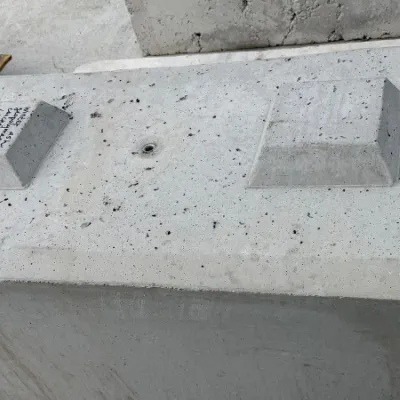
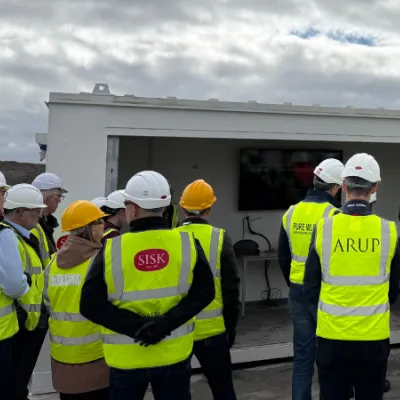
The work of Trinity’s researchers culminated in a product demonstration on a live SISK building site in Cherry Orchard, Dublin 22, with partners SISK, FLI Precast, and Roadstone. For the first time, low-carbon precast and site-poured biomass ash (sourced from forestry) concretes, made by the industry partners, were displayed and explained onsite.
FLI Precast produced the precast beams for the industry workshop, showcasing the compatibility of Trinity’s geopolymer concrete with industrial manufacturing processes. Roadstone mixed, transported, and poured the biomass ash-PC onsite to demonstrate its similarity to concrete made with Portland cement. Lastly, SISK validated the handling and placement of the low-carbon concrete components in a live construction site.
“Seeing this material placed on a live construction site was a strong moment for everyone involved. Our goal has always been to create something that industry can use today, without major disruption. This approach gives Ireland a practical route to lower‑carbon construction while making real use of an Irish waste resource.”
Researcher at Trinity College Dublin
The event also gathered Enterprise Ireland, the Land Development Agency, the National Standards Authority of Ireland, Transport Infrastructure Ireland, and the Irish Concrete Federation. This reflects the interest in low-carbon concrete solutions and in developing learning about the development of R&D capabilities in the Irish construction industry.
Maria Estrada, Senior Sustainable Design & Carbon Manager for SISK, said the Tier One Contractor's partnership with Trinity is key towards fulfilling its sustainability ambitions.

“We have a low-carbon concrete research group, uniting leaders across different disciplines in the business, to identify opportunities to work with innovators in sustainable construction materials. The project on Trinity’s biomass ash concrete is an example of where this collaboration succeeds. As concrete consumers, we are responsible for decarbonising our industry. We are in a privileged era where research has accelerated the progress of sustainable product innovation.”
Senior Sustainable Design & Carbon Manager for SISK
The SISK Innovation & Design team will continue to work with Trinity to improve the sustainability of operations. The company will also continue to build R&D skillsets and partner with research-performing organisations to complement these capabilities.
FLI Precast was another partner. The Trinity team regularly travelled to the Co. Carlow-based precast manufacturer to use its in-house laboratory and batching plant to test material in development. This was vital in assessing and validating commercial viability.
Luke O’Connor, Chief Engineer at FLI Precast, lauded the partnership with the university:

“Trinity’s innovative research aligns perfectly with our vision to pioneer sustainable practices, and we are proud to support scientific advancements that drive sustainable industry solutions.”
Chief Engineer at FLI Precast
With the first phase of this project complete, the Trinity researchers are seeking funding to further this research and promote the use of this material in construction projects. Zehao says Trinity will “connect waste producers and end users through an accessible platform”, to show concrete producers and ready-mix builders this biomass-based concrete offers more sustainable production without compromising on the structural properties of PC concrete. With this objective in mind, Trinity and its industry partners will continue working together to explore wider adoption across Ireland’s built environment.