Researching and Developing the Right Concrete Products and Application Systems for 3D Construction Printing
3D construction printing is still in its earliest phase in Irish building, but research into the best-practice materials and applications of this type of Modern Method of Construction (MMC) can help increase the rate of uptake. Two researchers from the Construct Innovate unit of the University of Galway are making this happen.
Concrete has long been the foundational material for the construction industry in Ireland. From concrete security huts to multi-storey developments, the nation is built on concrete.
Even Modern Methods of Construction (MMC) retain a significant place for concrete. Indeed, statistics from the Department of Housing, Local Government and Heritage show that 36% of all housing schemes nationwide using MMC are built with some form of concrete technology, with that figure rising to 88% of apartment complexes using MMC.
But while reinforced concrete, masonry blocks, Insulated Concrete Formwork, or precast concrete are established or increasingly popular materials, 3D construction printing remains at a test phase in Irish construction. Although Grange Close in Dundalk, Co. Louth, recently became the first development in the UK or Republic of Ireland with 3D-printed homes, it is still the exception to the rule.
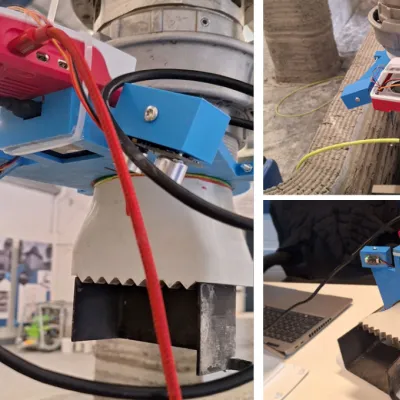
Two researchers from the University of Galway’s Construct Innovate are making strides to develop more advanced concrete products and application systems for 3D construction printing. Dr Pouyan Ghabezi and Dr Alireza Rahimi have recently published two separate research reports and submitted two papers on the topic, bringing considerations such as reuse of waste materials in concrete mix development and automated quality control for 3D printing to the industry.
Dr Ghabezi elaborated on why this research comes at a key time for the Irish construction sector:

“3D construction printing is much quicker than typical methods of concrete building. Also, with printing there is a major reduction in waste materials as onsite you only deploy what is needed. With both factors considered, you could see a 50-60% total reduction in carbon output on projects using 3D construction printing.”
Assistant Professor at the University of Galway
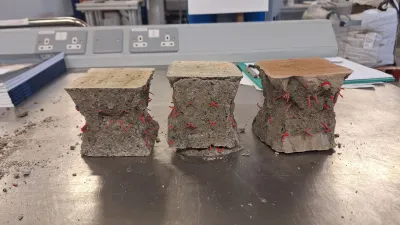
The first research project, 3DREDO, is focused on transforming plastic and composite waste into reinforcement material for concrete structures. Traditionally concrete has used embedded steel bars prone to corrosion for internal strengthening. This project explores a sustainable alternative using specialised filaments made from waste polymers, reinforced with carbon fibres, to create durable, 3D-printed lattice structures to replace steel bars.
The AQUA3D project is structured around four core objectives that address the limitations of manual data collection in 3D construction printing and establish a foundation for automated, real-time quality control. This establishes a baseline of manufacturing accuracy and repeatability across different 3D construction printing platforms, and helps to reproduce quality benchmarks to support certification in automated construction.
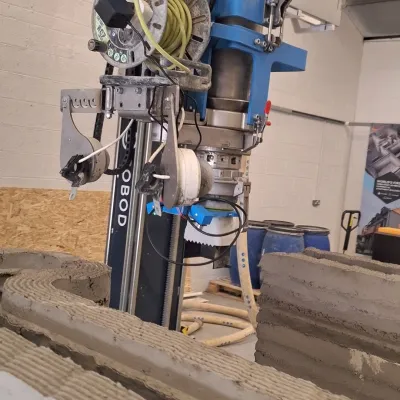
To initiate these projects, Dr Ghabezi and Dr Rahimi engaged with Harcourt Technologies (HTL.tech) for the use of the company’s research & development facility in Drogheda, Co. Louth. The facility is the only location in the country with a 3D concrete printer and also invests in concrete mix testing and development, making HTL.tech ideal partners for these projects. The pair of researchers also engaged with innovation education centre Future Cast (based in Co. Leitrim) for expertise on 3D construction printing.
Dr Ghabezi and Dr Rahimi also had the support of Construct Innovate, Ireland’s national research centre for construction technology, and Enterprise Ireland.
Dr Rahimi shared the topics attracting interest from Irish academia and industry:

“There are lots of opportunities in Ireland for researchers in the construction and advanced manufacturing sectors to delve into topics augmenting operational production, such as material testing, machine learning, and data science.”
Postdoctoral Research Associate at the University of Galway
Dr Ghabezi added to this dialogue, highlighting that these topics, among others at the forefront of digital construction, can be challenging for small companies to engage with.
“Some of the major skills gaps to construction companies adopting 3D concrete printing are materials testing and product development, mechanical and robotics engineering, and digitisation roles. Luckily, we are seeing a number of Irish universities, including University of Galway, starting to address these gaps.”
Assistant Professor at the University of Galway
These research projects are a step in the right direction to promoting a greater culture of research and development into areas at the forefront of construction, whether in digital sensor technologies or, very palpably, creating more sustainable concrete mixes.
Dr Ghabezi and Dr Rahimi both relocated from their native Iran to the West of Ireland in pursuit of research opportunities in their mutual areas of interest within construction and engineering. And both were highly complimentary of the research and development environment in the University of Galway and around the country more generally.
“In Irish academia, it’s wonderful to see the theoretical research and technical knowledge developed in real-world applications. It can be challenging to find a funding pipeline for projects, but that can be dependent on the topic.”
Postdoctoral Research Associate at the University of Galway
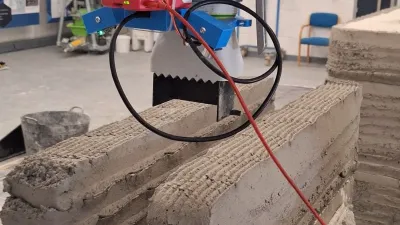
As to the potential impact of the 3DREDO and AQUA3D projects, it is too early to tell how this research will be applied on Irish 3D construction printing projects. Dr Ghabezi speculates that, though this research offers insight into ways of improving 3D construction printing, work still needs to be done to encourage a broader uptake in the technology.
“Currently, it will be a while until we have an optimised, scalable application system for 3D construction printing, partly because there is no Irish standard for mass building this way. Another hindrance to adoption in Ireland is helping people to understand that 3D printing doesn’t mean a reduction in construction quality.”
Assistant Professor at the University of Galway
However, Dr Ghabezi is hopeful this could soon change – with the potential for a major shift in the way that Ireland is built long term:
“Get developers and builders interested in the time, resource, and sustainability benefits of the technology, and that could change. Or, certifying 3D concrete printing could potentially build the demand. Any shift in these factors, and we could see multi-story, 3D-printed developments sooner than we could otherwise expect.”
Assistant Professor at the University of Galway