The Offsite Production, Project Coordination, and Onsite Installation of ICF
Among the many benefits of Insulated Concrete Formwork (ICF) is Leanness. From manufacturing to coordinating site delivery on to assembly, ICF offers more efficient development. Amvic ICF has put a number on this efficiency, saying its ICF system 'delivers your [construction] program 25% faster'. Learn how Amvic ICF achieves this.
Despite the number of developments in Ireland built with concrete, there are simply not enough block workers to sustainably meet demand into the future. The Central Statistics Office, in its Construction: A National Perspective 2024 report, identified only 3.8% of workers as in bricklaying or masonry roles. How can the industry address this deficit? In two ways: making working with concrete simpler, and opening these roles to workers with a greater range of skills.
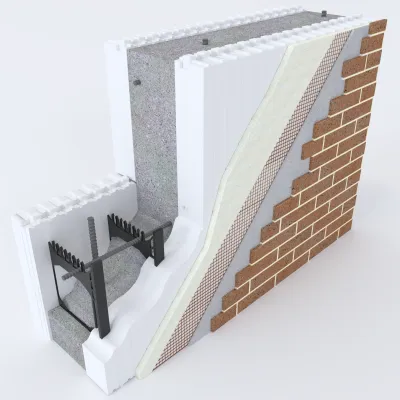
Insulated Concrete Formwork (ICF) is a product innovation that meets these needs. Lightweight ICF blocks are manufactured from two expanded polystyrene (EPS) foam panels connected with ties, which are filled onsite with concrete. Light to transport, no need to measure and cut blocks.
Pat Martin, Director of Amvic ICF, notes this Modern Method of Construction (MMC) is gaining traction in the Irish building sector: “The big players ... are still timber frame and traditional blockwork, but ICF is growing very rapidly as a percentage. It could be as high as 18-20%”.
How does ICF building run compared to traditional blockwork? Kostas Visnarauskas, Senior Production Manager at Amvic ICF, shared his perspective on the production side of the operation.

Kostas is responsible for supervising the manufacture of ICF systems of more than 520,000 square metres of ICF across Amvic ICF's production facilities in Co. Dublin and Co. Longford.
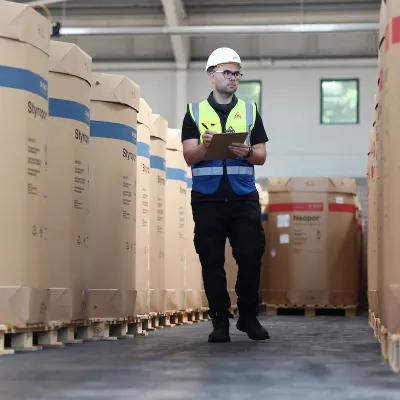
This starts with ordering raw material for production, loose polybeads. These polybeads are pre-expanded with steam, to give ICF blocks their well-known thermal efficiency. After 'resting' for 24 hours, to ensure the polybeads are structurally stable, manufacturing begins. The aerated polybeads are moulded around plastic connectors, then cooled and stored for dispatch.
General Operatives facilitate each step of the production line, perform spot quality checks, and pack stock – all supervised by Machine Technicians with ICF experience and the technical expertise to change moulds and address machinery issues. Kostas and the team can keep a close eye on quality and material usage, to minimise waste and ensure efficient production.
The General Operatives at Amvic ICF don't need any specific trade background, with Kostas saying that training in all elements of production and stock taking typically takes around two months. As such, Amvic ICF has much greater flexibility in finding talent to join its operations.
As for Kostas, his own skills have primarily been developed on the job:
“I studied engineering in Kaunas University of Technology but, when I moved to Ireland, I joined Amvic ICF as a Machine Technician. The company was much smaller then, so I took on additional work in team supervision, logistics, business development, and more. Realising ICF's potential, I also researched how the product is manufactured and could be optimised. I was first promoted to Shift Supervisor, then to Production Manager.”
Senior Production Manager at Amvic ICF
Kostas expanded on this, covering the unique blend of technical knowledge acquired through on-the-job learning and formal training on the physics of concrete and the soft skills needed to excel:
“The capacities needed in my position are complex and varied, covering a few roles in one – electrician, people manager, production coordinator, and salesperson for ICF.”
Senior Production Manager at Amvic ICF
While the on-the-job learning and formal training Kostas has done to date feeds into his current role well, he also said he has more to learn about Lean manufacturing:
“Lean is an area of my professional knowledge I want to return to developing. I have done Lean training before and the concepts fascinated me. For example, our current level of material wastage in manufacturing the ICF blocks is 0.5%. As a percentage of production, it's nominal. In Euros and cents, it's a lot. Training in that area would really help me to distinguish what can be changed to reduce waste further.”
Senior Production Manager at Amvic ICF
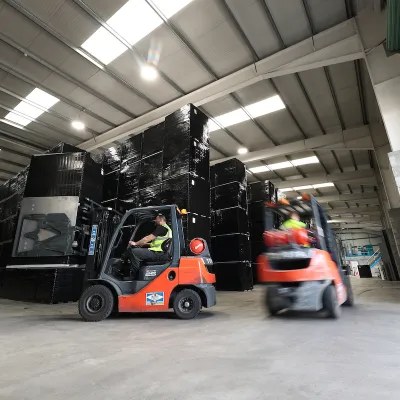
With ICF blocks manufactured to near-optimal efficiency with limited wastage, orders need to be coordinated and delivered to reliable site installation contractors experienced with ICF. Without this, the thermal efficiency, ease of transport, and speed of assembly with ICF are nullified.
Pascal Ennis, Senior Quantity Surveyor, plays a crucial role in ensuring Amvic ICF's projects run on time and to budget, and putting that ICF system is in expert hands onsite.

“From what I've seen in the past 20 years, blocklayers and bricklayers—in the traditional sense—are becoming a thing of the past. ICF system assembly doesn't require a trade, and Amvic can train installers in all of the skills needed to become certified and excel.”
Senior Quantity Surveyor
To this end, Amvic ICF offers CPD design workshops—online, in-facility, and onsite—to show how the system works. While these sessions can provide installers with the technical knowledge of the formwork system and practical assembly and installation skills, Pascal says the most valuable skill that onsite contractors can bring to working with ICF is adaptability.
“Anyone moving into MMC and ICF, whether that's manufacturing or installation, needs to be willing to adapt and determined to re-skill as required as the industry changes. It's the most important skill anyone that wants a career in construction can have nowadays.”
Senior Quantity Surveyor
With more efficient and Leaner manufacturing offsite, and certified installers maintaining high-quality standards onsite, Amvic ICF can gain greater certainty of build times. Indeed, Pascal says block systems can be delivered to site and installers ready 'within two weeks from first order'.
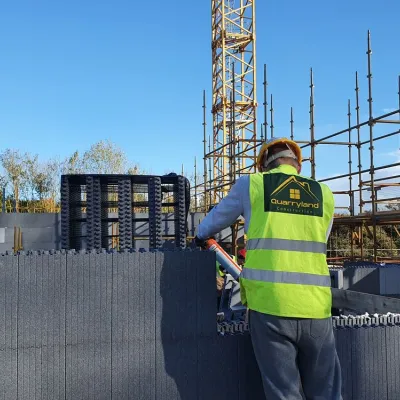
One example of an installer experienced in the Amvic ICF system is Alex Yourell of Quarryland Construction. The company already had experienced ICF installers when they started working with Amvic ICF, so it wasn't about learning how to build a superstructure from scratch. What the Quarryland team found particularly useful was the technical support behind the system.
“We adopted ICF quite early and made a real effort to understand the product and process behind it. We used Amvic ICF on a couple of projects and what stood out was the level of knowledge and involvement from the team. They wanted to be involved in the design, solve problems, and improve the overall level of knowledge in the ICF industry. That suited the way we wanted to work. We didn't just want to install blocks; we wanted to understand the system properly and be involved in delivering projects correctly.”
Quarryland Construction
Alex talked about how onsite installation of the Amvic ICF system was made seamless because of the company's detailed technical installation guide. Additionally, a Technical Manager joins team planning meetings to advise on structural design, concrete specification, and installation.
He added that Quarryland installers use an inspection app to upload photographs and notes during key construction phases, with each inspection geo-located. This feature is particularly useful when working on larger developments because Quarryland can identify exactly which structure the inspection relates to and store this information for quality control.
Offsite production, project coordination, and onsite installation with ICF is Lean and sustainable, with less waste in manufacturing, easier transportation, and less strenuous labour. It has a prominent place among the Modern Methods of Construction now defining Irish building.
Skillnet MMC Accelerate is hosting its next Business Support Event at Amvic ICF's production facility in Farranyoogan, Co. Longford, on 10 September 2026. Register today to see how Amvic ICF leads the way in ICF production, project coordination, and installation.
Related
-
 Equalising Traditional M&E Engineering with Prefabricated Electrical Installations from Skilled Factory Operatives
 -
 How can Housing Development be Optimised with Leading Precast Concrete Solutions?
 -
 The National Construction Manufacturer Taking Long-Standing Precast Concrete Technologies into the Future