Connecting a Skilled Construction Supply Chain to Offsite Manufacture Modular M&E Systems
As society becomes more reliant on data centres, it will become important for mechanical and electrical (M&E) systems in these facilities to be manufactured and assembled seamlessly within the construction supply chain. Modular engineering—designing and fabricating steel structures for M&E systems offsite—is an area that Hilti Ireland is advancing in, with the help of partner Global Steel.
Ireland’s emergence as a ‘data centre capital’ stems from a number of factors – but chief among them is an English-speaking workforce highly skilled in technology and engineering. Indeed, an EU impact assessment report on strengthening Europe’s cloud and AI ecosystem shows that Ireland tops the EU’s rankings on data-centre capacity. If facility development and management is key to maintaining this excellence, modular engineering of mechanical and electrical (M&E) systems for these facilities is also key.
Modular engineering of M&E systems offers several benefits over traditional engineering practice, including faster project scheduling and delivering, greater accuracy of cost estimation, superior quality control of systems, and reduced need for onsite labour.
Fortunately, Ireland has several major global engineering firms equipped to provide these modular engineering services in the design, build, and deployment of data centre developments. But, to deliver, firms need the right supply chain partners onboard.
A key partner in this area may come as a surprise to many in the industry – Hilti Ireland. The multinational is best known as a tool supplier for the global construction sector.
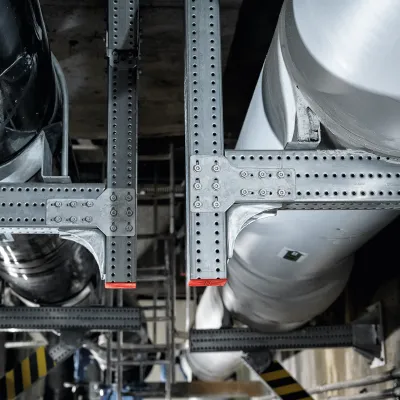
However, in seeing building companies in Ireland move towards Modern Methods of Construction (MMC), Hilti Ireland has strategically expanded its offering to include modular M&E support systems such as pipe and cable trays, and access platforms. The systems are designed to be simple to assemble once onsite, making it easier for site contractors to find appropriately skilled people to install these M&E support systems.
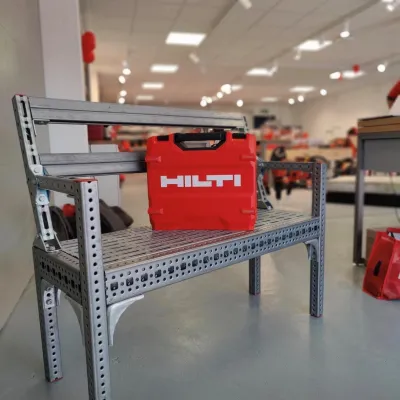
Hilti Ireland, using specialists in partner Prefabrication Centres, perform a range of modular engineering services such as kitting components, cutting strut channels, and full offsite pre-assembly of steel support systems. This helps M&E engineers to improve project productivity by reducing costs and installation time while maintaining quality.
This explains why modular engineering services have become increasingly in-demand in recent times. It also explains why Business Development Manager Rory Duff was brought in, around a year ago, to help lead Hilti’s Offsite Manufacturing Division.

Rory joined Hilti Ireland after nearly two decades’ experience in building, particularly in steel fabrication. He started as a Metal Fabrication Technician working with stainless steel for Global Steel Manufacturing (more on them later). He eventually moved up to Production Manager level, before switching focus to sales and business development. In November 2025, he was offered the opportunity to build on Hilti’s brand name in steel prefabrication for modular systems – a new role he has fully immersed himself in.
He describes “having to learn a lot and adjust quickly” in taking on his new role, though he already had previous experience in modular engineering and MMC in a previous role. Rory also says that Hilti Ireland, within the Offsite Manufacturing Division and beyond, “works with staff to identify new opportunities in the business and support upskilling in that area”. This all made the transition into the business much more seamless.
Rory’s day-to-day responsibilities includes linking clients (the M&E engineers developing solutions for data centre projects, for example) to contractors, as well as assisting these contractors with finding and developing appropriate modular systems.
One such contractor for Hillti’s modular engineering projects is one of Rory’s past employers, Global Steel Manufacturing. The specialist steel manufacturer operates from new purpose-built premises, fitted with modern fabrication machinery, in Enniscorthy, Co. Wexford. The company offers specialised modular engineered systems to a range of industries, including food processing, pharmaceuticals, telecommunications and, of course, construction. Hilti is the company’s largest building-sector client, and Global Steel has a dedicated team for these contracts.
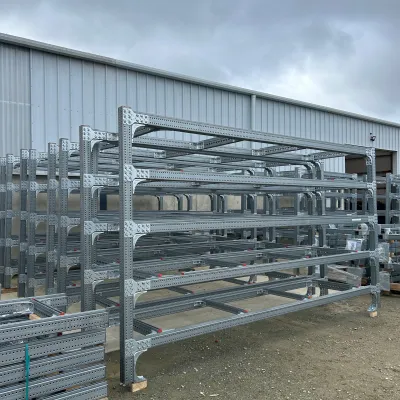
Saul Saunders is Team Lead for these Hilti contracts, managing steel fabricators and Module Assembly Technicians in delivering modular M&E support systems. With 30+ years of experience in construction, Saul talks about starting his career working for Gercon Engineering manufacturing chandeliers for Waterford Crystal, before he moved into steel fixing, both onsite and offsite. With all this accumulated experience, Saul emphasises the benefits that can be found in offsite manufacturing rather than onsite steel welding:

“Offsite manufacturing takes the guesswork out of building. When you build onsite, everyone has a slightly different interpretation of a drawing, or attentiveness to quality checks. With Modern Methods of Construction, you can have faith structures are designed with offsite manufacturing in mind, and rigorous quality checks before anything is fixed onsite makes certain of that.”
Team Lead for Global Steel Manufacturing
Saul’s team fabricate steel components and pre-assemble modularised elements for the M&E support systems where possible, streamlining works down the track and ensuring design clashes and quality checks are addressed before going to site. This is possible because the streamlined and non-trade focused nature of construction in offsite manufacturing lowers the skills barrier for different people to enter these roles.
“In general, offsite manufacturing for M&E systems is a little easier to bring people into than even wider modular construction. It’s easier to bring in General Operatives and train them in general construction skills and assembling a specific modular system than it is to find qualified Steel Fixers – there just aren’t the numbers of them, and operatives can pick up module assembly quickly.”
Team Lead for Global Steel Manufacturing
One example of this in action is with a key member of Saul’s team, Lucy Kehoe. A Module Assembly Technician, she assembles and finishes modular units, interfacing with steel fabricators while performing simple assembly work, as well as quality checks, to ensure the readiness of modular systems before transportation to site.

“I have definitely gained transferrable skills while in this role, such as technical drawing interpretation and problem solving. However, I didn’t need any metal fabrication skills to start with, which really opened the door for me. The modular steel structures we put together are not much different than flatpack furniture, so anyone can learn how to do the job quickly and easily.”
Module Assembly Technician at Global Steel
Further to that point, Lucy pointed out that these generalised skills requirements, plus the advantages of regular rostered work in a safe and secure indoor setting, made this type of construction role more appealing for her than a traditional job on a building site.
“Everyone should give construction a go – if you get to work offsite. I wouldn’t be in this job if I wasn’t able to work in a controlled factory environment, at regular hours, just 10 minutes down the road from where I live. I finish at 4pm every day and I feel like I have my whole evening to live my life and not spend it in a car. Before this I was working in a shop, and my hours were far less predicable.”
Module Assembly Technician at Global Steel
Saul had the final word on the effectiveness of offsite steel prefabrication, which explains why Rory engaged Global Steel on their modular engineering contracts:
“We started this project for Hilti Ireland a month late, but, with the efficiency of offsite manufacturing, we are now three months ahead of schedule. Our small team can easily prefabricate 40 fully assembled frames per month now.”
Team Lead for Global Steel Manufacturing