How Does the Supply Chain Sustainability School Partner with Construction Firms for Insightful Industry Training?
In just over two years, the Irish Supply Chain Sustainability School has developed a suite of e-learning modules relevant to key sustainability topics such as the circular economy and sustainable procurement. Freely available to its members, it has proven a key resource for builders nationwide, including major firms such as Kirby Group Engineering. How Does the Supply Chain School partner with construction companies to deliver leading industry training?

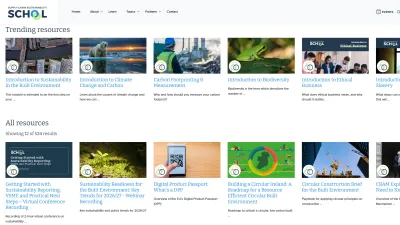
In early 2024, a new resource launched for the Irish construction industry to learn more about sustainability in the built environment sector. The Supply Chain Sustainability School Ireland, based on the UK programme operating for more than a decade, offers free learning resources and CPD-accredited content. Training on key topics enabling the industry to become more sustainable includes waste, resource efficiency and the circular economy; energy and carbon management; sustainable materials; and more.
This virtual learning platform is ideal for subscribed construction professionals to upskill flexibly, and for free, in skills core to Sustainability and Environmental-focused job roles. This requirement becomes more urgent when you consider the changing requirements for building companies coming down the track. This includes more stringent regulations from the Environmental Protection Agency, Local Authority Standards, and a broad range of policies to come with the introduction of the Zero-Energy Building standard.
Andrew Wilson, Programmes Manager for the Supply Chain Sustainability School, said that, despite the reality of this situation, many construction companies don’t take a comprehensive-enough view of operations to make truly impactful sustainability changes.

“The majority of carbon output and other factors relevant to overall operational sustainability come from the company supply chain, rather than onsite building. Improving operations onsite, and even applying Lean principles in offsite manufacturing, will not be as impactful without looking at the whole supply chain.”
Programmes Manager for the Supply Chain Sustainability School
Andrew noted the common skill gaps construction companies often face include measuring carbon output; managing waste reduction and management; and ensuring equity, diversity, and inclusion in operations, onsite and offsite. The Supply Chain School offers free e-learning materials and live webinars in this area, to help companies better understand and implement sustainable practices. Networking and partnership opportunities at in-person and online events gathering industry, Government, and training providers are also key to disseminating messages around sustainability transformation.
How can the Supply Chain School offer these resources free of charge? A network of construction industry clients, contractors, and suppliers across Ireland with a mutual interest in building skills within supply chain operations. Supply Chain School is also partnered with public sector bodies such as Enterprise Ireland and associations such as the Construction Industry Federation, as well as a range of different training providers.
With this mosaic of supporting organisations, including Ireland’s largest construction companies, Andrew thinks this top-down knowledge sharing will “help all boats rise on a high tide” in adopting sustainability principles.
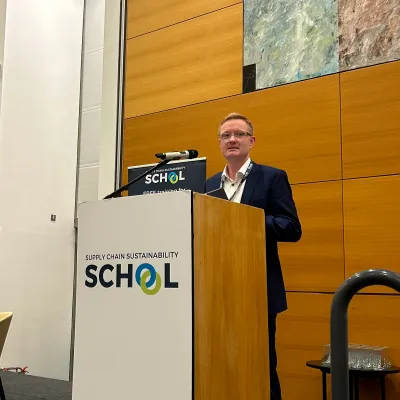
“Upskilling can be costly – our partnerships with large organisations that want to invest in skills development and drive the construction sector forward ensures our members can access our resources for free.”
Programmes Manager for the Supply Chain Sustainability School
One such example of this partnership is with major Irish engineering firm Kirby Group Engineering. The company directly employs more than 1,900 staff and has a turnover of €930 million. In recent years Kirby has increasingly focused its attention on its sustainability efforts, informed by its corporate Sustainability Strategy & Roadmap. This strategy provides a clear framework for integrating sustainability into business decision-making, driving decarbonisation, strengthening governance, supporting responsible supply chains, and creating long-term value for stakeholders.
Beyond this, Kirby has demonstrated its commitment to improving the sustainability of operations by contributing to founding the Irish branch of the Supply Chain School in 2024.
It was only a few months after that Jason Doherty, now Head of Sustainability at Kirby, joined the business.

Within less than a year, Kirby launched its first Sustainability Training Plan based on delivering four training modules, sourced from the Supply Chain School, to staff across 2025. These courses included: Introduction to Sustainability in the Built Environment; Introduction to Ethical Business; Carbon Footprinting and Measurement; and lastly Introduction to Climate Change and Carbon. The Supply Chain School also delivered a series of workshops and webinars for Kirby employees covering climate change, carbon management, sustainable procurement, and social value.
Jason pointed to the importance of aligning training with its broad-level strategies around sustainability to demonstrate the company is actively upskilling staff in the right areas.
“Increasingly we are seeing clients looking for upskilling in relevant sustainability topics and they look for a focus on learning and development at a company culture level. These changing times in the construction sector means that construction professionals need to get more proactive with their career planning and training.”
Head of Sustainability at Kirby
Kirby has responded by introducing a Learning & Development department charged with upskilling staff and contractors across all areas of the business. Key to the department’s responsibilities is developing targeted career pathways tied to relevant training for individuals and teams. This covers everything from mandatory health and safety training to open-access resources on sustainability, as offered with the Supply Chain School’s e-learning.
Andrew discussed how the Supply Chain School have more closely partnered with Kirby this year to support the company’s skills development in key sustainability topics.

“Since the start of 2026, we have been working closely with Kirby to support the delivery of its sustainability training programme. Together, we have developed a series of learning opportunities focused on reducing carbon, embedding circular economy principles, and designing out waste, helping employees build the knowledge and skills needed to support Kirby’s sustainability ambitions.”
Programmes Manager for the Supply Chain Sustainability School
Jason adds that these modules, once they are delivered in dedicated workshops to the Kirby team, will be embedded on the company’s internal training platform. This will supplement the resources covering Lean principles and offsite manufacturing that already exist on the platform for the team based in Kirby’s manufacturing facility in Co. Laois.
“This closer training partnership comes at an advantageous time for Kirby as we have launched our Sustainability Strategy earlier this year. The Supply Chain School has helped me to plug gaps in my own learning in some key sustainability areas, and the team has been very good in developing training tailored to Kirby's needs.”
Head of Sustainability at Kirby
Skillnet MMC Accelerate partnered with the Supply Chain School recently too, to ensure both Initiatives supporting companies working in Modern Methods of Construction can avail of the most advanced resources supporting talent building. With partnerships between companies and training providers flourishing, there is an opportunity for the Irish construction sector to meet and exceed its sustainability targets in years to come.