How Can Digital Design and Offsite Manufacturing Maximise the Value of M&E Engineering?
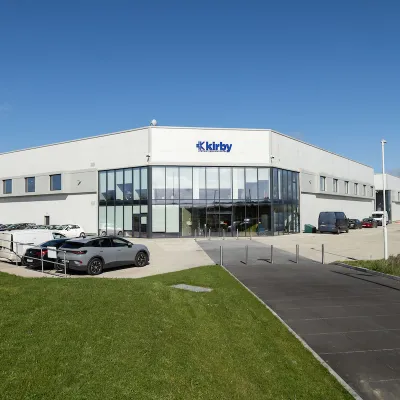
Kirby Group Engineering is a leading mechanical and electrical (M&E) engineering contractor operating across Ireland, the UK, and mainland Europe. Kirby provides full M&E contracting services, as well as specialist high voltage (HV) and medium voltage (MV) design, and construction services to clients across a number of different sectors including Data Centres, Life Sciences, Industrial, and Power and Renewables. The company uses offsite manufacturing (OSM) and digital construction, operating from a 10,000sqm facility in Co. Laois, to drive efficiency throughout the build process.

Offsite manufacturing (OSM) provides incredible savings across hours spent onsite, amount of equipment onsite, scheduling control, quality control and, of course, safety. Offsite manufacturing also enables seamless coordination across all aspects of construction.
Data centre construction involves major structural work, with many kilometres of containment, pipework and cable to install. Offsite manufacturing on these projects brings about project efficiencies that allows schedules to be condensed. As an example, offsite construction eliminates the need to wait for a building to be weather-proof to start a project – critical for the tight schedule data centre projects often have.
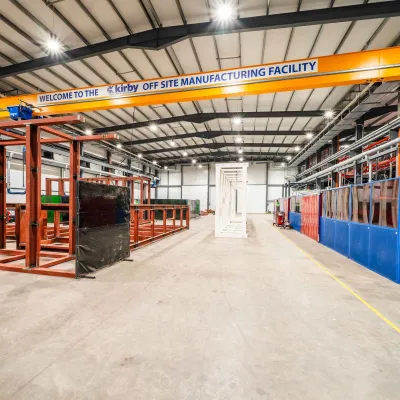
Large projects would traditionally have hundreds of people working onsite at once. This would involve people working at height and across different pieces of equipment. With offsite manufacturing, modules can be assembled on the ground, transported, then installed onsite. This saves time, equipment onsite, and improves sustainability.
Mark Danaher, Director of Digital Construction & IT at Kirby Group Engineering, discusses the strategic importance of offsite manufacturing to a firm adept in traditional engineering but that has always had an eye on Modern Methods of Construction (MMC).

“We aim to complete 25% of our projects through prefabrication methods, and our offsite manufacturing facility is central to achieving that target.”
Director of Digital Construction & IT at Kirby Group Engineering
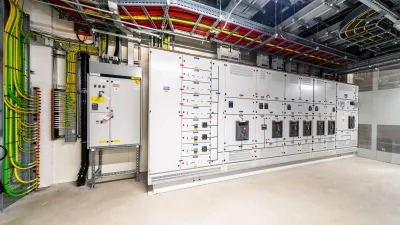
One of the earliest projects that Kirby worked on involving offsite manufacturing was a 60MW data centre in Dublin in 2021. The firm worked with an external supplier to prefabricate entire electrical switch rooms in modular units, which were shipped to site to be installed by Kirby’s onsite teams. This project was the culmination of years of investigations into prefabrication and demonstrated what could be achieved.

To realise the ambition of prefabricating high-quality mechanical and electrical (M&E) modules, Kirby opened its €8 million offsite manufacturing facility near Portlaoise, Co. Laois, in November 2024. It has since doubled to a 10,000sqm facility providing manufacturing, engineering, and digital construction services to clients across Europe. Items manufactured at the facility now include e-houses, electrical rooms, package plantrooms, electrical modules, mechanical modules, external pipe / containment racks, pump skids, riser modules, and other bespoke installations.
“A drive to unlock value for our clients — in a variety of industries — saw us explore prefabrication and modularisation, aided by digital construction.”
Director of Digital Construction & IT at Kirby Group Engineering
The digital side of prefabricating M&E modules is just as key as the manufacturing. Kirby started using digital construction software Autodesk as far back as 2006. Before that point, like many engineering firms, Kirby would have relied on an architectural plan to develop and design the relevant aspects of the project at hand.
Today, Kirby Group Engineering’s digital team works on 3D digital models hosted on the cloud in real-time, utilising software to coordinate the process for modular manufacturing. The team first builds a 3D model of the project, which automatically syncs to the manufacturing facility. Data is imported into the manufacturing systems to plan production schedules, track inventory, and manage product output quality.
The team on the ground will see, for example, a digital version of a piping system, with all the material needed from the 3D model broken down and a parts list automatically generated. Everyone on the production floor has access to a digital screen and the system informs them of the jobs they have for the day, the amount of pipe they need to cut, and the cutting dimensions. With this software, the manufacturing facility manager also knows what’s required to build the necessary component and what parts to order.
Mark expanded on the company’s approach to maximising the value of digital technologies, in aid of more effective and streamlined construction processes:
“We have always been early adopters of new technologies. When I joined the business, we were tendering a large project that had a Building Information Modelling (BIM) element. As one the first data centre projects utilising BIM, others might have thought it was an outlier. Instead, we saw an opportunity to deliver excellence, and now 14 years later every single one of our projects utilises digital construction as standard, whether it’s a requirement or not.”
Director of Digital Construction & IT at Kirby Group Engineering
This approach combining digital design with offsite manufacturing, while beneficial to developing high-quality M&E modules, requires an investment in talent development.
Kirby Group Engineering’s Portlaoise facility includes a purpose‑built training centre, complete with specialist training rigs allowing the firm to teach and assess the digital and engineering skills needed for execution on data centre projects. This practical training is combined with working onsite, and compliments classroom-based learning at college.
Kirby's internal and external training covers upskilling for professionals at all career levels:
- A Graduate Programme offering thought-provoking work assignments and quality personal, management, technical and commercial training.
- An Apprentice Programme giving apprentices technical training, practical work challenges, and personal development and support.
- The High Potential Project Manager Programme combines training, mentoring, and hands-on experience with academic learning through Trinity Business School, equipping participants with a Higher Diploma in Project Management and the skills to become future leaders.
- A Leader as a Coach Programme designed to help managers become coaches with hands-on exercises, practical tools, and structured conversations.

Mark explained how this approach to upskilling is helping Kirby to remain at the forefront of digital design and offsite manufacturing capabilities in Ireland.
“There is a skills shortage in M&E engineering led by an ageing workforce and shortage of blue-collar workers. We’re investing in initiatives to support and grow engineering talent from the ground up. Firms must radically scale how they develop talent by moving away from static training models, instead embedding continuous, structured upskilling at every level. The future will be built on a combination of technical skills, digital capability, and continuous upskilling.”
Director of Digital Construction & IT at Kirby Group Engineering