“Making Construction More Accessible to People” – How Manufacturing Production Staff Fit into Offsite Timber Frame Building
The benefits of offsite manufacturing include greater production efficiency and improved quality control. But for the people ‘on the ground’, the positives are more personal. Opportunities to diversify skills, dependable commutes, and safer working conditions are just a few ways the modern construction workforce is benefitting from Modern Methods of Construction (MMC). See how DTE Manufacturing is offering an accessible career in timber frame offsite manufacturing.
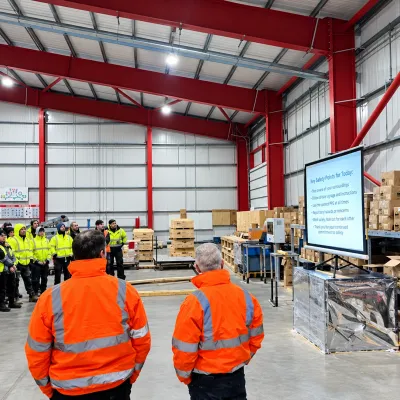
In the move towards MMC, the pros for the business and the employee often go hand in hand. The builder, when operating at the right scale of production, can increase delivery while improving quality, plan operations more effectively, and reduce the numbers of staff required in an already-restricted workforce. For people working in offsite manufacturing, this model gives them access to what many in traditional construction never had – a regular working location and a 9-5 indoors.
That’s why many Irish companies are pivoting operations around MMC. Even timber frame, one of the most traditional forms of building, can be done offsite and panels or other components simply assembled onsite. This model is key to one company’s growth at a modern production site.
For DTE Manufacturing, the journey to its current MMC-enabled production capability all started at Scratenagh Cross, outside Arklow in Co. Wicklow. Initially just building roof trusses, management realised there was a changing attitude in Ireland to MMC and identified the major potential of the offsite production of timber frame panelised structures. Acquisition by Glennon Brothers Timber in 2007 further altered DTE Manufacturing’s priorities.
With these changes, DTE Manufacturing experienced a rapid period of business growth that quickly exhausted the space available in its Arklow facility. In 2020, the company decided to move to a new purpose-built factory and office site in Co. Longford at the Glennon Brothers headquarters, with 120+ staff across design, manufacturing, and onsite teams working for the timber frame manufacturer.
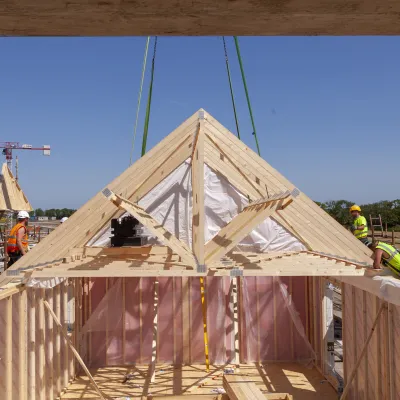
Daragh Keran, Head of Timber Frame at DTE Manufacturing, offered a comprehensive overview of how the company produces its timber structures from design models to assembly onsite.

The team first uses a coordinated 3D design process to resolve details in the structural information of wall panels, floor systems, and roof structures, before manufacturing begins. These design files are then converted for the automated machinery, reducing the chance of manual errors.
The system divides the timber structure into unique elements, with staff at each workstation interpreting the model and manufacturing these elements to required specifications. Components are then cut and processed before panels are framed, openings cut, and patterns fixed in a repeatable production sequence.
Completed panels are labelled, weather-proofed and assembled into packs in the correct erection sequence, ready for onsite assembly. Construction kits are then loaded in a planned order so the installation crew can assemble the timber fame structure in the correct order.
“MMC is not just about building the same way but in a factory. It is about standardising and improving the overall process, from design to manufacture to onsite installation.”
Head of Timber Frame at DTE Manufacturing
This process requires a thorough understanding of construction and manufacturing, as well as Lean principles and digital tools. For DTE Manufacturing to have its employees truly excel, the company has invested in a comprehensive training programme in its manufacturing operations (as well as the other sides of design and onsite assembly), regardless of their past experiences.
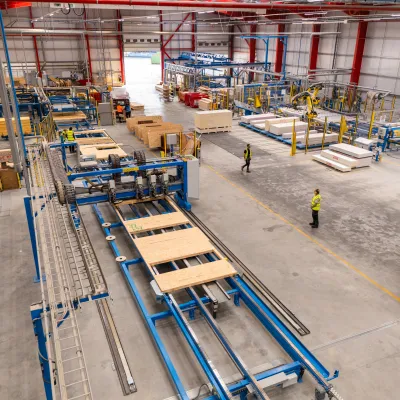
DTE Manufacturing starts by training new production staff in timber frame terminology, material identification, equipment operation, and quality requirements. Employees are then trained at individual production stations with experienced floor operators to pick up practical skills in machine operation, understanding production data, recognising faults, and process recovery.
“The factories that will succeed will ... be the ones that combine the right technology with capable people, reliable processes, and a culture of continuous improvement.”
Head of Timber Frame at DTE Manufacturing
Training is built through a structured upskilling matrix in the company's academy. This defines competencies for each role and provides a clear career pathway in offsite manufacturing for staff to, according to Daragh, “progress into more skilled operational, technical or supervisory roles”.
This training approach is different to typical trade upskilling as the required skillsets are broader. Daragh says that employees need to understand construction principles, digital systems, automated machinery, quality assurance, lean manufacturing, and data-driven improvement.
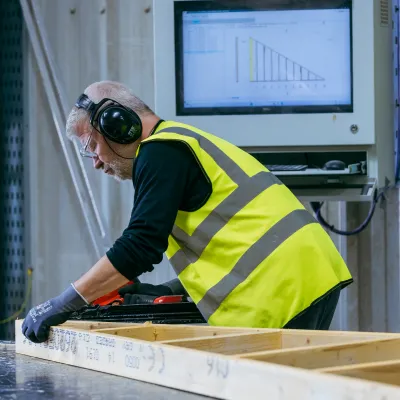
“Offsite manufacturing can make the construction industry accessible to people who may not have followed a traditional apprenticeship path. We need experienced tradespeople, of course, but we need machine technicians, production planners, digital designers, manufacturing engineers, logistics coordinators, and quality control technicians too.”
Head of Timber Frame at DTE Manufacturing
Enda Shannon, Plant Manager at DTE Manufacturing, is a typical example of the skillset and experience that, while atypical to traditional construction, is vital in offsite manufacturing.

While Enda started his career in construction as a setting-out engineer and site foreman, after the 2008 Recession he moved into manufacturing as a machine operator for a food packaging company. After switching to medical device production, Enda began to advance his career with training in Lean principles as he advanced from Line Lead to Team Leader to Production Manager. Undertaking Six Sigma training, he advanced from White Belt to Yellow to Green Belt, helping his company to streamline production and improve the manufacturing process.
Through all this, Enda wanted to return to the construction sector – with the right opportunity.
“By the time I started in my leadership roles, I had a young family, so any move back into construction was delayed. The Medical Devices industry is such a highly regulated and demanding environment that it can be challenging for managers to sustain consistently high performance over the long term, and there came a point where I made the decision to move on. When in early-2025 the opportunity at DTE Manufacturing arose, I thought it was a great chance to get back into construction and thought it would be a perfect fit for the building and manufacturing experience I had gained over my career.”
Plant Manager at DTE Manufacturing
Enda's daily tasks include production meetings with each shift, managing floor operations, and assessing the team's competencies to maximise efficiencies. Enda is responsible for two Shift Managers, who in turn manage six Shift Supervisors and a team of 100+ General Operatives.
One such General Operative is Klaudia Pliszczyńska. Klaudia has an extensive background in manufacturing, like Enda, having previously worked in a dog food factory for nine years.

“Working a mix of day and night shifts, working weekends and bank holidays, really got tiring after all those years. At DTE, I work regular 9-5 hours, I'm only a 10-minute drive from the factory, and, although I already had some basic building skills, I have learned a lot in only a year. I'm delighted to have time again for friends and family.”
General Operative
Among the skills Klaudia has developed in her time at DTE Manufacturing, she has learned the basics of timber frame cutting, machine operation and design interpretation, which she sees as a “major skill, in manufacturing or onsite”. Indeed, Klaudia has already had opportunities to advance these skills within her working hours, being invited to join company management training as a high-performing operative with an eye to advance to a supervisory role in the near future.
This promotion of offsite construction skills has been key to DTE Manufacturing's success. It also shows how the Irish building sector has embraced upskilling as key to the workforce of the future.
“The culture has changed significantly since I was in construction – there is now a bigger focus on upskilling. Multiple people in the business are studying externally (in areas like supply chain and robotics). DTE supports staff, from technicians up to management, to keep their career and skills here.”
Plant Manager at DTE Manufacturing
Related
-
 ‘Making Innovation Core to the Industry, Giving Opportunities to Graduates’ Through Training and Mentorship at Construct Innovate
-
 Gucci, Dulux, Castle Modular – How a Commitment to Upskilling Brought Sinéad Vaughan to Offsite Construction
-
 What does the National Standards Authority of Ireland look for in MMC Certification Officers?