How Do Lean Principles Link Better Offsite Prefabrication and Onsite Construction?
For major construction companies, partnering with offsite manufacturers using Modern Methods of Construction (MMC) offers a compelling route to making the most of MMC. Lean construction principles, and training in this area, helps to link the offsite with the onsite and maximise the effectiveness of this form of building.
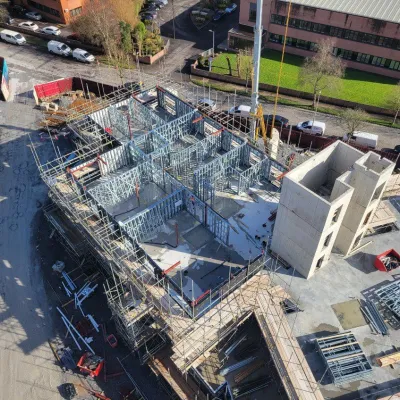

Dozens of companies have set up operations all over Ireland in recent years in the move towards adopting Modern Methods of Construction (MMC). Spanning different construction systems and categories within the MMC framework, one key element uniting many of these construction businesses is that much of the innovation occurs offsite. Whether that is fabricating modular units or manufacturing ICF blocks, the operational focus of these newer companies often moves from onsite to offsite.
But for more established construction companies, such as Clancy, the onsite assembly and installation of these innovative MMC systems (in partnership with companies manufacturing offsite) is integral to project success.
Associate Director of Clancy Des Riordan notes the firm, with origins dating back to 1947, started their journey into adopting MMC as far back as 2015 with the embrace of Lean construction principles.

“We wanted to achieve greater consistency and certainty in project delivery. There were too many unknown factors in the attainment of our targets, so we started our journey with Lean by using the Last Planner System. Working with a private training provider, we first tested the platform on key projects while supporting upskilling in it for our staff and contractors. We then rolled it out at a business-wide level after we saw the impact on project delivery and staff buy-in. One fed the other, which created synergy and consistency almost immediately.”
Associate Director of Clancy
“In the wake of Covid-19, there was a real opportunity for us to get involved with the rapid-build emergency healthcare projects countrywide. We were contracted to design and build two emergency ward blocks in University Hospital Limerick and Croom Hospital. By utilising all our expertise in MMC while enthusing an unyielding focus on collaboration in delivering these critical bed spaces within 16 weeks, we demonstrated that this new way of working provides a collaborative platform to achieve certainty in delivery. Clancy partnered with Remagin Ireland as our offsite contractor for the structure and from this success went on to build the largest ever student accommodation development in Cork City at that time.”
Associate Director of Clancy
From then, Clancy adopted offsite construction as a key tool in their toolbox. Clancy works with a range of MMC companies, with their needs differing project to project. Des notes that Clancy favour LGS for developments over three storeys, a panelised timber frame manufacturer for developments of two or three storeys, and ICF from Amvic ICF for certain housing types. Des also says that Clancy is open to further MMC partnerships, especially if companies are already using the Last Planner system.

“We want to get to a point of consistency with all our sites across the country, regardless of who we partner with, where all onsite processes are intertwined and the variable circumstances site-to-site are accounted for before works begin and seamlessly as the project progresses through the necessary stages to successful completion.”
Associate Director of Clancy
In this operational predictability comes efficiency. Lean construction principles are key to this, as well as knowledge of the practical application of MMC systems. So, the upskilling offered by Clancy to staff and implementation with sub-contractors was crucial to success. Clancy is a founding member of MMC Ireland, where the team benefits from exclusive access to information on developments in the MMC space. The Clancy team also gain insights from Construct Innovate’s regular webinar series and the broader MMC ecosystem.
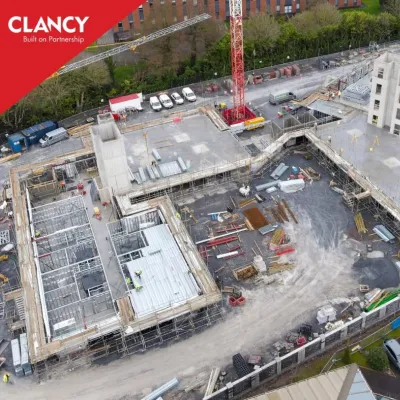
More formally, Clancy has received funding from Enterprise Ireland through the Built to Innovate programme to support upskilling for Clancy team members in a variety of areas. All Clancy staff are enrolled in Lean Six Sigma Yellow Belts and in turn progress to Green Belt status. Additionally, a number of the Clancy team have completed Griffith College’s course in Strategic Collaboration and Coordination for MMC, to ensure MMC techniques are at the forefront of innovation within the company.
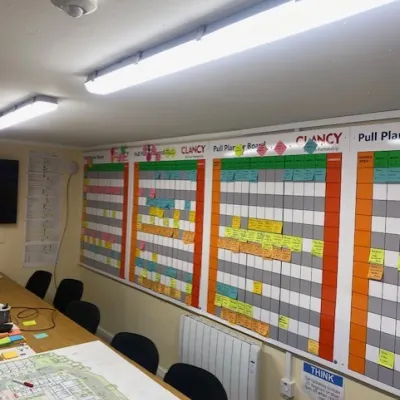
“At Clancy, we certainly aim to keep increasing our knowledge of MMC. Apprentices and subcontractors coming into the industry also need this training in Lean and MMC. And that training needs to be made appealing enough to negate the upfront costs and the time workers are away from the site.”
Associate Director of Clancy
This is a key point of upskilling for Damien Riedy, Senior Site Manager with Clancy.
Damien is undertaking a Master’s degree in Construction Project Management through South East Technological University, with his thesis focused on the perspective of subcontractors on MMC. This intensive upskilling is a common for Clancy staff, with Damien noting that Clancy puts several candidates forward for this type of training every few years, to ensure the company keeps on top of advancing ideas in MMC.
It also ensures that the likes of Damien, with his role onsite interacting with all types of subcontractors, can advocate for Lean construction and MMC in all onsite activities.

“Fundamentally it’s still the same processes in traditional construction and MMC. Steel is still steel, and water and air still move in the same way. MMC just means more planning in advance and better integrated operational processes for, often, faster and higher-quality project delivery. I keep manufacturers and installers very engaged in how we do things. They need to understand what they are building AND why they're building that way. With Clancy’s focus on skills development, they are excellent at mentoring others through new learning.”
Senior Site Manager with Clancy
Ian Beakey, Project Manager for Remagin Ireland, offers the perspective of an offsite manufacturer partnered with Clancy. Before moving into site management, Ian spent around 12 years assembling and installing LGS frame systems across Ireland and the UK. This hands-on experience gave him a strong understanding of what’s required onsite, sequencing requirements, tolerances, and the challenges that can arise.

“This experience meant changed my approach to construction site management. I became much more focused on preparation and early issue resolution, with a strong emphasis on ensuring design details are complete, interfaces with other trades are pre-coordinated, and the site is readied before installation. This proactive approach helps maximise the advantages of prefabrication, reduces delays on site, and improves overall project delivery.”
Project Manager for Remagin Ireland
Referring to a recent project in Cloverhill, Co. Cork, Ian’s role was to coordinate the various stakeholders involved in project delivery, including Remagin Ireland and Clancy. This involved ensuring design information, procurement, manufacturing, and site installation were all aligned to support the overall construction programme.
With LGS, many decisions that would traditionally be made onsite needed to be made during design and prefabrication, to ensure greater efficiency in assembly. Ian’s knowledge of onsite installation, supported by Clancy’s approach to Lean construction onsite, contributed significantly to the successful delivery of the project.
“Based on my experience, I would encourage anyone considering offsite construction to embrace the change. Success in this area is driven by developing skills in planning, coordination and early decision-making, rather than fixes onsite as needed. It’s not just an alternative system for building.”
Project Manager for Remagin Ireland
Related
-
 ‘Making Innovation Core to the Industry, Giving Opportunities to Graduates’ Through Training and Mentorship at Construct Innovate
 -
 Gucci, Dulux, Castle Modular – How a Commitment to Upskilling Brought Sinéad Vaughan to Offsite Construction
 -
 What does the National Standards Authority of Ireland look for in MMC Certification Officers?