Equalising Traditional M&E Engineering with Prefabricated Electrical Installations from Skilled Factory Operatives
Traditional construction often calls for specialist contractors to cover different trades. One of the benefits of offsite manufacturing is the production process can negate this need for different skillsets, instead requiring General Operatives adaptable to multiple roles. Castle Group uses Modern Methods of Construction (MMC) to flip the script on the skills requirements of M&E installations.
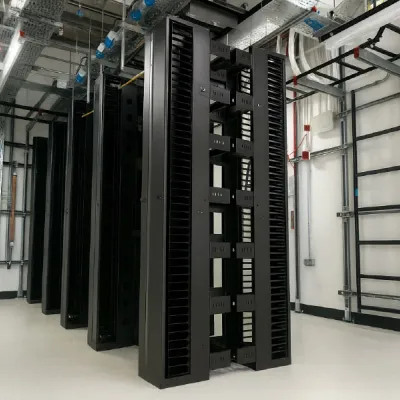
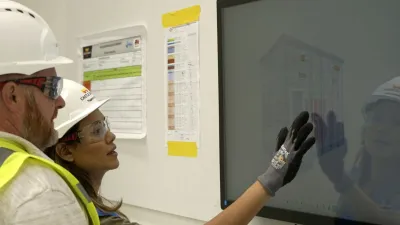
Co. Galway-based Castle Group’s expansion into the world of modular construction started in 2018, making it one of the longer-serving Modern Methods of Construction (MMC) business in Ireland. The-then newly formed Castle Modular first tested the waters of MMC with the launch of a prefabricated bathroom pod for building projects. The company hasn’t looked back since, expanding into M&E installations and then a full volumetric modular solution for the Life Sciences and residential construction sectors.
Today, Castle Modular delivers innovative, high-quality modular solutions blending flexibility and precision for faster project delivery within accepted safety standards. This is particularly true of prefabricated M&E installations such as UPS modules and EPods (electrical pods) housing switchgear, transformers, and associated equipment.
Eoin Waldron, Head of Castle Modular, explained how working in a controllable offsite environment helps the division ensure higher quality production.

“We can take a more measured approach to inspection and approvals in a factory environment. It’s clean, dry, and dust free which means the likes of Quality Control Technicians can sign-off on modules more easily. Compare that to an onsite environment with a lot of moving parts, and quality assurance becomes harder to achieve in the same timeframe. With construction programmes so tight, time lost onsite to installation and the subsequent quality inspection of elements that can be manufactured offsite isn’t ideal. So, our modules leave the factory floor, fully finished, often with zero snags.”
Head of Castle Modular
For construction professionals, including tradespeople, this requires a change in mindset towards, as Eoin puts it, the ‘preconstruction phase’. Design coordination is vital in an offsite manufacturing context to gain the efficiency of standardised output. Any fixing of the module or electrical installation after it is designed inhibits effective production, so module manufacturers need skills in technical design interpretation.
Another change in skills requirements to excel in prefabricating electrical installations is an understanding of roll formers, CNC machinery, and other equipment that would typically be used in advanced manufacturing industries. These technicians help with the automation and accelerate of production while managing quality and consistency.
Working in an offsite manufacturing facility requires ‘all-rounder’ skills beyond the specific techniques taught in the trades to electricians. In an Offsite Production context, these individuals may be called, for example, Electrical Assembly Technicians or Module Assembly Operatives, to reflect their broader base of manufacturing skill.
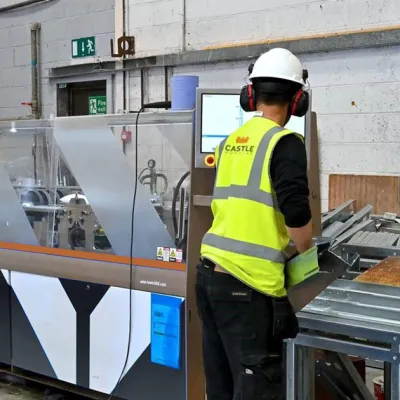
How does Castle Modular run its training to ensure its operatives can adapt to the multi-trade demands of working in modular M&E manufacturing? Eoin explained that, alongside hiring from a diverse range of construction-related backgrounds, regular training through its ‘Castle Academy’ is decisive to supporting staff upskilling:
“We do our own CPD sessions on everything from sustainability to Lean. Workshops are also led by the manufactures of our various types of equipment. We find that mixing onsite and offsite ‘on-the-job' training with our senior members of staff is also beneficial, bringing factory operatives out to site and installers into the factory, as a good approach. It gives the bigger picture.”
Head of Castle Modular
Mark Moran, Factory & Programme Manager at Castle Modular, typifies this approach. He is the former Head Trainer for the Castle Academy, with a background in traditional construction before moving to work in an offsite construction environment.

“I always enjoyed training – I trained so many apprentices over the years, for other companies and in running my own business. I love sharing the skills I have developed with others and seeing people learning to work to a high standard.”
Factory & Programme Manager at Castle Modular
Indeed, the full story is even more interesting. After working as Carpenter for 25 years, after the 2008 Recession he pivoted towards teaching. After studying Architectural Technology at the University of Limerick, he began working with the Galway and Roscommon Education and Training Board (GRETB) training apprentice carpenters. When Castle Group set up its Academy in 2016, he was the appointed GRETB trainer for teaching carpentry the Academy, before becoming the head of the Academy full time.
In late 2019, Castle Group were expanding into developing modular solutions, and Mark jumped at the opportunity to lead the venture in the new offsite manufacturing facility.
“I knew it would be a bit of a transition from teaching to supervising as a Factory Floor Manager. I did some of my own research into modular construction and discussed Seamus’ [Brady, Managing Director of Castle Group] vision at length. But it appealed to me, to build something from the ground up, so I went for it. I did CPD sessions to learn about modular building, and health and safety courses relevant to manufacturing, to ensure I was as prepared as possible.”
Factory & Programme Manager at Castle Modular
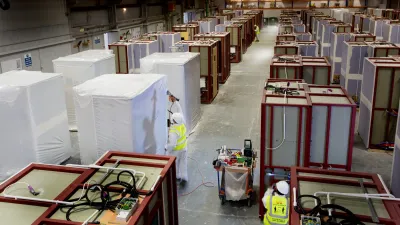
While Castle Modular started as a team of two, today it has expanded to 20+ office staff focused on digital design, procurement, and other functions. This doesn't include the diverse range of skills present on the factory floor, which include CNC Technicians, Steel Fixers, Module Installers, Project Managers, and Factory Floor Supervisors. All roles, no matter how junior, are trained to interpret digital designs and operate basic production machinery, to ensure people can fill in across several roles as required.
“We don’t have a predominance of certain tradespeople on the floor. To us, a multi-skilled General Operative is as vital as a qualified tradesperson because they are adaptable and willing to learn. With this focus on upskilling our team to do a bit of everything, we have good staff retention. Our lads also love working in an offsite environment as it’s stable, with no travel site to site in all weather.”
Factory & Programme Manager at Castle Modular
A key example of the pay-off in upskilling within MMC can be seen in the success of Castle Modular’s recent delivery of a 15 metre-long, 42-tonne UPS module for a pharmaceutical company in Co. Dublin. The Castle Modular team worked on the system design with energy equipment supplier Schnieder Electric and EDC Engineers but installed the module themselves at the site in Co. Dublin. This project was completed with minimal onsite disruption, thanks to complex detail work done in the design office and factory spanning nearly nine months of preparation pre-installation.
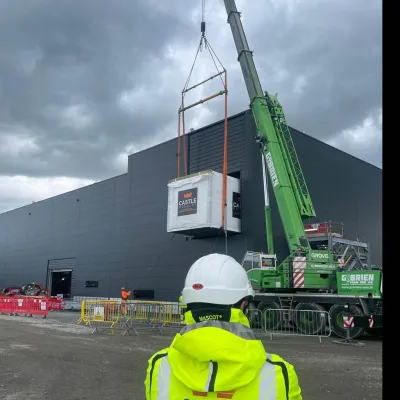
Front loading the work for enhanced quality and minimal site impact, no matter the requirements or scale of the project? There are the benefits of offsite manufacturing.