Driving Up Home Comfort and Driving Down Heating Bills with Sustainable Modular Construction
Modular units prefabricated offsite can offer major improvements in thermal efficiency and vapour control when compared to other types of builds. Big Man Modular shared how the small offsite builder in Co. Cork manufactures units with Structural Insulated Panels (SIPs) for maximum energy performance.
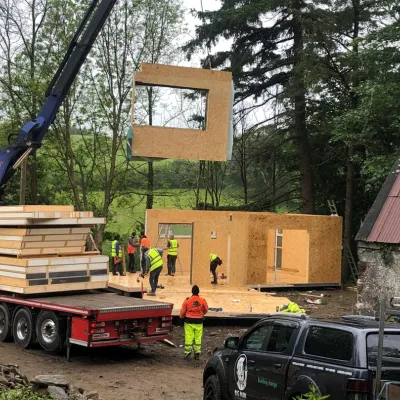
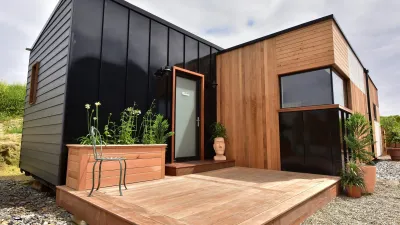
In the wake of years of disruption to global supply chains and increasing demands for lower carbon output from fuels, energy costs have rarely been a more pressing concern for Irish property owners. One way to address the spiralling price of heating your home? Housing designed and assembled using Modern Methods of Construction (MMC), with builds allowing greater airtightness control and thermal efficiency to keep costs down.
Modular systems show, in a nutshell, how to improve construction sustainability. Precision engineering modules within controlled offsite environments allows for greater quality assurance, while using ‘green’ construction products designed for better airtightness and thermal insulation contributes to more energy efficient houses.
Quality and efficiency are two of the ideals underpinning Big Man Modular, based in Bandon, Co. Cork, a company that manufactures, assembles, and installs ‘energy efficient, cost effective, sustainable homes’. Founded in 2018 as Big Man, Tiny Homes, founder JP Simpson adapted the business’ model to changing times and embraced modular construction in 2021. From there, the company has gone on to deliver housing projects for self-build clients across the south and west of Ireland.
JP Simpson expanded on his motivations for launching the modular construction brand.

“I was first exposed to the concept of modular building after working for a US construction company in Haiti delivering disaster relief projects. Seeing hospitals and emergency housing delivered to site and assembled in weeks was inspiring, and I thought ‘why can’t this be done in Ireland?’. At the time, tiny homes were becoming popular, so I started in that, learning as I went along. After the Ukrainian War and the other global incidents, I pivoted to modular construction as the concept became more widely accepted in Irish society.”
Founder of Big Man Modular
Today, Big Man Modular manufactures, assembles, and installs housing to various degrees of prefabrication. At the least ‘finished’ level, Big Man Modular augments Structural Insulated Panels (SIPs) sourced from construction partners SIP Energy in its Bandon workshop. Up the scale, the Big Man Modular team assembles building panels ‘finished’ with electrical fittings and insulation provided by MMC Eco Homes in Galway. Big Man Modular can also install fully prefabricated modular housing units onsite.
“Whether we are using SIPs or full modular units, we do 90% of all installs ourselves. If we aren't doing it ourselves because the client wants to use their builder, we will still supervise onsite. This way, we maintain quality control and can check the unit will offer maximum energy efficiency to the homeowner.”
Founder of Big Man Modular
This quality control is crucial to Big Man Modular as it ensures the company retains its reputation for sustainable modular construction. This starts with high-quality SIP panels from SIP Energy. The family-owned business, based in Athenry, Co. Galway, has been manufacturing insulated panels since the 1970s and started out manufacturing panels for the refrigerated market. In the mid-2000s, SIP Energy identified a gap in the housing market for a high-quality insulated system, and so expanded operations to fill this gap.
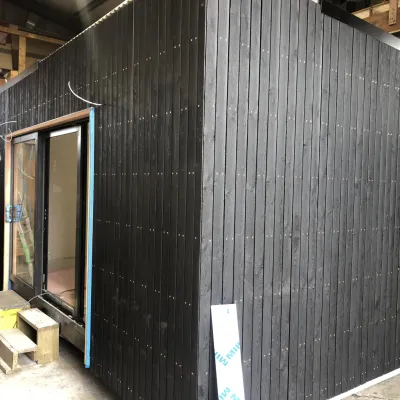
John Moylan, Sales & Support Manager for SIP Energy, expanded on this key decision.
“The heads of the business identified that homes weren't being built with the right attention to detail on heating efficiency and ventilation. Fuel scarcity, and therefore rising costs, were also seen as becoming a factor in the future. So, they decided to expand manufacturing Structural Insulated Panels into those for housing. What we did was to reverse the insulation properties of the technology used in the refrigeration industry, to keep warmth in instead of keeping cold in.”
Sales & Support Manager for SIP Energy
In 2007, when the company started to focus on housing, SIP Energy was achieving an air permeability of 3m3/hr/m2 at a time when traditionally constructed homes offered between 5 to 10 m3/hr/m2 - this was a major development in achieving more sustainable and energy efficient buildings. Now, John says they “meet and can exceed Passivhaus standards”, with projects achieving better than 0.6 m3/hr/m2.
“Insulation isn’t the only way to improve the energy efficiency and thermal performance of your home. Past a certain point, increasing the amount of insulation used in a building will increase the build cost by X%, without that spend corresponding to the same X% increase in thermal efficiency. Airtightness, bridging content, and vapour control are big parts of this picture too.”
Sales & Support Manager for SIP Energy
JP emphasised how using these SIPs — and the standardised, simplified nature of modular construction — helps Big Man Modular to deliver more sustainable builds.
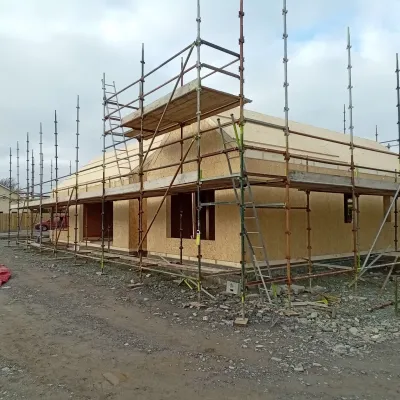
“Achieving airtightness is easy with the right products. SIPs are designed to be airtight, so you only need to airtighten the connections between the panels, unlike with traditional construction where you need to ensure each block or beam is connected appropriately. Onsite assembly of modular units also makes this type of sustainable building more accessible. It's not rocket science putting modules together – we only need a crew of four, with skilled Site Operatives and a Construction Supervisor, to complete a 200 square metre house in 12 weeks.”
Founder of Big Man Modular
And these homes aren’t just built to a high standard quickly – they are a leading standard. JP reports airtightness ratings in his modular homes of as high as 0.3 ACH, with A1 homes rated on the Building Energy Rating scheme only required to be 3 ACH. Indeed, JP refers an energy assessor having to recalibrate his machinery when checking the airtightness of one of Big Man Modular’s units to ensure the readings were correct.
Beyond that, the ease of assembly with modular units means less time spent onsite, meaning lower carbon output. Meanwhile, the controlled production of modular units in the Big Man Modular workshop means less waste materials (JP reckons up to two-thirds less than an equivalent traditional build), further reducing overall carbon output.
What does the future hold for sustainable modular construction? Big Man Modular will continue to construct modular homes for clients motivated by sustainability – an area that JP emphasises has high potential if builders upskill in sustainable construction.
“We don’t see a lot of subcontractors with the right training. They aren’t interested in more energy efficient construction. They are just focused on a lower bottom line for the client. But we find our clients often have sustainability in mind with their development. A hole the size of a €1 coin in your wall can mean 10 pints of water built up in the cavity within a year. That’s heat loss and property damage. We need to show builders the financial benefits for clients in building with this sustainability in mind. Subcontractors need training in NZEB. We offer that onsite, and there are education providers nationwide helping too.”
Founder of Big Man Modular
Related
-
 Offsite Prefabrication for Traditional Building, Onsite Installation for MMC Projects – Pipelife Ireland’s Heating Systems
 -
 “Reduce Onsite Labour, Minimise Installation Time” with Modular Construction
 -
 “If It Can Be Built Offsite, It Should” – Engaging Engineers with Offsite Manufacturing and Lean Principles for MEP Installations