Will AI Define the Future of Architecture? Standardising Design, Automating Tasks, and Optimising Production for Better Construction
Artificial Intelligence (AI) is augmenting work in every industry. Traditional architecture practices can benefit from the time- and resource-savings possible with AI. A new generation of architects need training in the tool to excel in their career. South East Technological University (SETU) and architecture firm Henry J Lyons Architects are leading the way here – linked by one enthusiastic graduate.
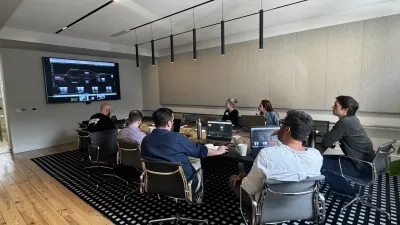
AI, while transformative for society, will be unable to replace creative practices. Professionals whose roles are based on design thinking and creativity, such as architects, can instead optimise their productivity and innovation with the digital tool.
AI will help reduce the amount of time and resources spent on repetitive, non-creative manual tasks. For architects, this means less time spent on developing visualisations for design ideations, compliance checking, parametric modelling, or analysing datasets. This also means more time that can be spent pursuing the human-centric heart of the position: bringing functional, beautiful, and sustainable buildings to life.
Conor Nolan, Part II Architectural Graduate at Henry J Lyons Architects knows first-hand the benefits of using AI in architecture practice – he literally trained for it, making him among the first in a coming wave of AI-native architects.

“A lot of the manual parts of architecture are imposed upon us. If AI can help reduce the time taken to handle documentation and reduce repeatability in tasks, I would think highly of architecture as a future-proofed profession.”
Part II Architectural Graduate at Henry J Lyons Architects
Conor started his Bachelor of Architecture degree in South East Technological University (SETU) in 2019. The early years of his course were impacted by the Covid-19 pandemic and the move to a digital-first way of teaching. But, in his final year of study, a more novel switch to technology-based learning would transform his career skillset.
Unbeknownst to Conor, SETU’s Department of Architecture and Built Environment was in the early stages of incorporating teaching about AI in architecture into the pedagogy. This was led by the Head of Department, Robin Stubbs, and Lecturer Garry Miley.
Garry started his career working an architect in New York. On his return to Ireland, Garry worked with Limerick City Council on major housing projects and urban design initiatives as well as overseeing the introduction of the Council’s building conservation programme. Since 2008 Garry has been teaching architectural studio, history and theory full time at SETU.

“The philosophy of the school is about embedding techniques in students. We aren’t waiting for inspiration on what to teach them, so we react to what is happening in the world to teach to a brief in a consistent and authentic way. We want to produce as well-rounded students as we possibly can.”
Lecturer at South East Technological University
Working with Robin, and driven by his interest in AI, Garry contacted Professor Phillip Bernstein of Yale University to determine how SETU could adapt their own teaching to this technological shift. Phillip suggested the two universities run a project linking Yale and SETU students, with Conor among the first cohort to take part. Students on both sides of the Atlantic learned about AI applications in architecture and then presented case studies for their suggested use of the technology in their own day-to-day practice.
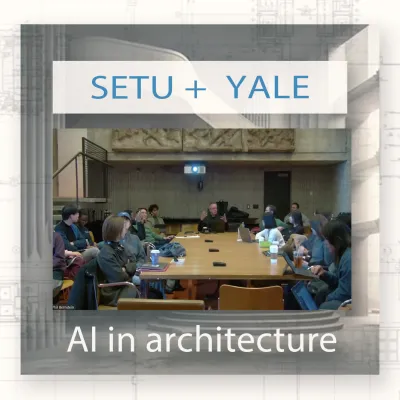
The pilot was such a success that Garry and Robin expanded the project into a full 5-credit module and introduced it a year earlier in the curriculum, to ensure more students picked up on the basics of using AI in architecture. The collaboration now features a series of co-hosted online lectures and workshops led by faculty from both universities, culminating in students completing an AI-focused research assignment.
“By working with a renowned institution like Yale, we can be sure our students are developing the AI skills and insights to thrive in a rapidly changing landscape. It’s a remarkable opportunity for everyone involved.”
Lecturer at South East Technological University
A bold step from one of the main universities in Ireland to bring its architecture curriculum to the cutting edge of application in the working world. But that’s not the end the story. For the pilot project, SETU invited architects nationwide to see what the next generation came up with. That’s when Conor, presenting a paper entitled ‘Training Custom Object Detection Models for Architectural Symbol Recognition’, met Breffni Greene, Head of AI and Design Innovation at Henry J Lyons Architects.
Breffni may have been the ideal person for a young architect with a passion for AI to meet. To complement his professional role, Breffni is the Chair of the AI Taskforce at The Royal Institute of the Architects of Ireland. Complementing his Professional Diploma in AI in Business (UCD), he has broadened his expertise to include the legal and ethical frameworks of the technology, recently completing a micro-credential with the Law Society of Ireland alongside advanced coursework in governance.
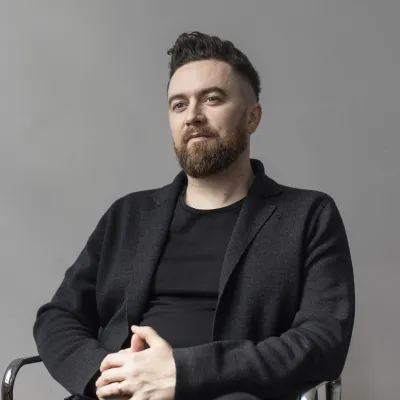
“It’s not just an area of interest – it’s fundamental to the future workplace. We can't wait around to come to a consensus about a structure or guidance on how to introduce this. Individuals across the industry are using AI for their own needs right now, so we need to react accordingly, adopt responsibly, encourage experimentation, and to teach how to optimise the way people use it for better design.”
Head of AI and Design Innovation at Henry J Lyons Architects
Breffni leads AI adoption at Henry J Lyons Architects, championing architects as stewards who command tools and workflows throughout the design process. AI is one tool amongst many, supporting collaboration and decision-making without replacing the professional expertise or judgement that is fundamental to successful design.
“As architects, we have a responsibility to build AI literacy across the practice. We began with a top-down approach, but discovered that those actively using the tools and required more training tended to be more junior staff. Each studio and department has distinct needs, readiness for change and varying degrees of technological knowledge. Addressing this gap was crucial to eliminate ‘shadow AI’ and ensure everyone understands both the opportunities and the risks.”
Head of AI and Design Innovation at Henry J Lyons Architects
Breffni added:
“Importantly, our use of this technology does not absolve us of our professional responsibilities. We must act professionally, fulfilling our duties to employees, clients and the public. This means complying with current legislation whilst building robust policy and a framework of safeguards that support growth and experimentation in a fast-moving field.”
Head of AI and Design Innovation at Henry J Lyons Architects
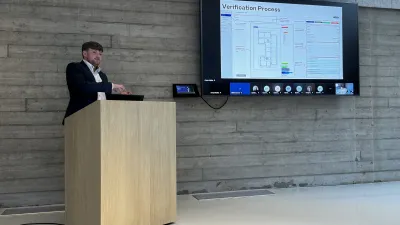
After seeing Conor’s presentation, Breffni consulted with him and his lecturer, Garry, on his AI research and how he planned on deploying the tool in professional practice. This led to an offer for Conor to join Henry J Lyons Architects as a graduate architect focused on AI research and development. With the firm since July 2025, Conor has been involved in numerous projects to expand the use of AI in operational design.
Breffni says Conor is ‘an inspiration’ to others at Henry J Lyons Architects as he is totally native to using AI in architectural practice in a way an experienced architect isn’t. Breffni added that ‘graduates can have skills the current workforce does not’, pointing to the training at SETU in AI as critical to developing work-ready skills for architecture graduates.
“Third-level institutions have an obligation to help students develop the skills they need to succeed in practice. This means identifying and anticipating industry needs, matching them with expert research and teaching, and ensuring graduates' skills are future-proofed. AI literacy is now an essential skill in the workplace and must be embedded in architectural education.”
Head of AI and Design Innovation at Henry J Lyons Architects
Third-level institutions reacting to developments in the market to give young building professionals the skills needed to succeed, and businesses offering opportunities for graduates to build careers and transform the industry. It’s the perfect loop of self-improvement to drive Irish architectural practice forward. Conor has the last word on his experience learning about AI at SETU and implementing it at Henry J Lyons Architects
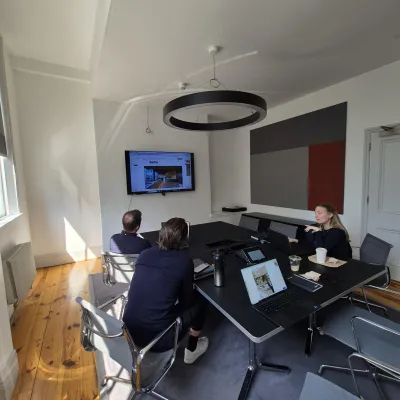
“I was fortunate to explore AI at SETU, gaining skills not commonly found among architectural graduates. That experience secured a unique role with Henry J Lyons Architects, where I can develop further. I expect future cohorts to possess deep AI knowledge, making them particularly valuable in the job market.”
Part II Architectural Graduate at Henry J Lyons Architects