Why Millions of Users Globally Deploy Dalux for Leaner, Digital Construction Management
Dalux, while a global brand with 55 offices and users in 147 countries, serves its Irish clients out of Co. Dublin with a small team of experienced professionals. The construction management software provider remains at the forefront of 3D BIM visualisation technology thanks to a focus on working with people skilled in the intersection between digitisation and Modern Methods of Construction (MMC).
Although Dalux had been serving customers in Ireland for years, the software provider only opened its first Irish office in 2023, “to help our Irish clients grow their business,” according to Brendan O’Riordan, Country Manager for Ireland.

“We have a good market right now, with a high level of employment, and generally a lot of construction going on. And when everyone is running as fast as they can, there are big advantages to be gained by implementing digital tools that can make the work processes just a little bit smarter. With Dalux, you can have BIM software that is simple and easy to use, regardless of whether you’re standing onsite in a muddy hole in the wind, or in the office getting to grips with the consultant’s latest design changes.”
Country Manager for Ireland, Dalux
Dalux offers a user-friendly ‘source of truth’ linking all contractors together through a single platform. Openness is inherit to the design of the software, as is the transparency of a universal process for logging, accessing, and analysing project data. This latter point is particularly key, says Customer Success Manager Garreth Tackney.

“We have seen customers, before using Dalux, that communicate via email, WhatsApp, phone calls, and even print out notes. And everyone has a personal preference and nobody is aligned around one method of sharing information. Dalux bridges that gap, ensuring everyone is on the same page about a project.”
Customer Success Manager, Dalux
Garreth was brought into Dalux just a year after the Irish office opened to work with optimise customers’ use of the software and ensure they are fulfilling project potential.
A prime example of this was in a recent project Dalux consulted on for an Irish modular building company. The modular builder needed to track the installation of their façade system by an onsite team during a hotel development in central Dublin. The façade system, comprising 320 individual panels, was manufactured offsite but once installed onsite it was difficult to quality assess the cavity. With Dalux, the modular builder could log photos and installation details for the onsite team. These teams could respond with photos of the finished installation for review – all in real time, all instantly accessible.
Another company that uses Dalux software is Castle Group, based in Co. Galway. Prior to integrating Dalux into its document management and quality control processes, Castle Group used multiple platforms to fulfill these needs.
Niall Hardiman, Contracts Manager at Castle Group, expanded on this point:

“We used to find that lack of interoperability between our different digital construction platforms challenging, with one for design planning and another for quality control and design. Dalux brought these two together in one solution.”
Contracts Manager at Castle Group
After an assessment period, Dalux was rolled out across Castle Group’s operations, and is now the preferred digital construction project software of choice. Niall added:
“Of course, our clients may have there own internal processes for design planning and quality assessment. But this can be across multiple other software packages, or via email or messaging. Where we can, we recommend our clients use Dalux, to ensure we are fully integrated in the full construction process.”
Contracts Manager at Castle Group
Niall adds that, down the track, Castle Group will broaden its use of Dalux software. The company intends to implement a feature integrating a design workflow that ensures Document Controllers and Design Managers can issue technical submissions to senior management internally, or clients, for approval. This will streamline communication and ensure there is a digital record, in one place, of all document signoffs.
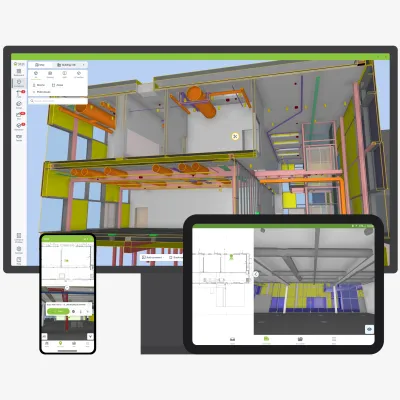
“Digital construction is an important part of the industry. Construction gets a bad reputation for not being digitised enough. What we have seen is that’s unfair, particularly in the Irish market. More than half of the projects we are involved with already had some element of MMC when we came onboard. We have found people to be generally open to learning about digital construction.”
Country Manager for Ireland, Dalux
Upskilling is central to the Dalux ethos. As with most software providers, Dalux provides training courses through its ‘Dalux Academy’. Courses are designed around the role of a typical user working on a best-practice project, with learning interconnected to provide a view of Dalux functionality from multiple perspectives. But Dalux takes this commitment to upskilling in digital construction further than many.
For a start, Dalux offers an ‘educational partnership agreement’ for training providers that want to bring Dalux products into their curriculum, with free access to training resources so learners can explore various features and digital construction concepts.
The company also offers training opportunities for employees, in Ireland and beyond.
“When you start at Dalux, you start in the ‘Academy’, just like our clients – your diary is full, no matter your role. Outside of company history and general product details, training is specified to you. We also offer budget for training outside the company, as well as a senior leadership programme taking place in Denmark.”
Country Manager for Ireland, Dalux
This approach aligns closely with both Brendan and Garreth’s feelings on upskilling. Brendan says “people need to be constantly upskilling, while Garreth has returned to construction training across his career. He completed a course in Computer Programming at Dundalk Institute of Technology (DkIT) and also studied Power BI, to further his knowledge of how to build digital tools. But perhaps most relevant to his current role is a Lean Six Sigma (Green Belt) course undertaken at DkIT.
“I wanted to become more effective in process creation and implementation. The course concepts were very manufacturing based, but this really ticked the MMC box and exposed me to that industrialised, systematic way of building.”
Customer Success Manager, Dalux
Garreth also said he wants to expand his knowledge of data analytics for the building sector (a core part of the Dalux software), to further develop his career in the next year.
Dalux enables leaner, digitised construction management for clients. But the software provider also makes the principles of digital construction core to its staff recruitment and training. This will help the company stay at the head of the Irish building industry.