What does the National Standards Authority of Ireland look for in MMC Certification Officers?
Kevin Ryan, MMC Certification Officer with the National Standards Authority of Ireland (NSAI), says you need a “diverse range of very specific skills” to be suitable for work in MMC certification. How did he develop the skills to excel in his position and what does the NSAI look for in granting certification to MMC companies?

Companies specialising in Modern Methods of Construction (MMC) are constantly innovating with new materials, systems, and processes to make building faster, more efficient, higher quality, cheaper, more sustainable, and more advanced. The sticking point? These new materials and building systems are often not covered by EU Directives / Irish Building Regulations as they haven’t had longevity of use or cannot be held to pre-existing regulations and/or a set of standards.
Agrément certification is used to specifically certify novel building products or systems, assessing safety, durability, and compliance with EU directives and national regulations. An Irish Agrément Certificate also ensures that innovative new materials and building systems are fit for purpose in Ireland’s often wet and windy climate.
The objective of the Modern Methods of Construction (MMC) Unit within the National Standards Authority of Ireland (NSAI) is to provide a pathway to help Irish and overseas-based MMC companies attain the necessary certification for these innovative building systems.
Claire Lane from the NSAI’s MMC Certification Team, put it this way:

“The MMC Unit was established in response to this growing interest and need for alternative construction methods, particularly in the offsite and modular sectors, to help achieve targets under the Government’s new housing plan, Delivering Homes, Building Communities, and the current Irish Programme for Government. Our work involves a thorough assessment of these systems, including everything from the design process and materials used to manufacturing practices and installation methods onsite, ensuring safety, durability, and compliance.”
Certification & Inspection Officer, NSAI
Kevin Ryan, MMC Certification Officer, emphasised the precise nature of his remit:

“The NSAI cannot consult or advise on how to adopt Modern Methods of Construction, or implement these principles in the R&D of new products and building systems. There are consultants who can instead help in that area. We are here to facilitate maintaining the standards coordinated by industry experts coming together and, from my own MMC certification perspective, to provide assurance that building systems comply with the Irish Building Regulations.”
MMC Certification Officer, NSAI
For Claire and Kevin, day-to-day work involves researching and reviewing the building systems and construction details of companies applying for MMC Agrément certification, and meeting with applicants to review their technical documentation. Kevin says this balances desk-based responsibilities and work ‘on the ground’ assessing products developed and used in MMC building systems, both in a factory setting and onsite.
Companies can find support materials in the NSAI’s online MMC Toolkit, including the detailed Guide to Agrément Certification for MMC. After sending an application through the NSAI portal, an MMC Certification Officer will undertake a preliminary assessment and provide feedback on the application. This is to give applicants a clearer picture as to the entire assessment process and what additional information may be needed.
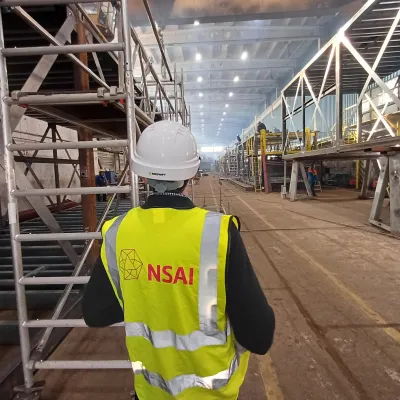
After the project scope and contract have been agreed, the MMC Certification Unit will develop a Technical Assessment Specification incorporating fire, acoustic, and structural assessments, along with other laboratory testing results such as the calculation of U-values and thermal models, a condensation risk analysis, and more. A simultaneous Factory Production Control audit means conducting manufacturing facility inspections, onsite evaluations, and reviews of quality control processes. This illustrates the combination of desk-based technical reviews and site visitations that MMC Certification & Inspection Officers are required to do.
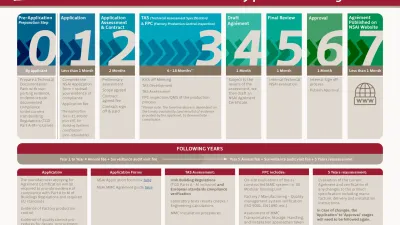
Once the MMC Certification & Inspection Officer assigned to the MMC file is satisfied that all technical and quality criteria are fulfilled, the system’s MMC Agrément Certificate is drafted for an initial review by the applicant. After the applicant signs off on this draft, it is again reviewed internally within the MMC Certification Unit by an independent MMC Certification & Inspection Officer not familiar with the file and, when all is in order, approved by the NSAI for publication.
It’s clear that a range of technical and soft skills are required across the whole process of MMC Agrément certification. Kevin said you need a “diverse range of very specific skills” to fit within the spectrum of technical and aptitude requirements of an MMC Certification & Inspection Officer – and to excel in this role.
Claire came to her position as a MMC Certification & Inspection Officer with a background in offsite construction, working first as an Architectural Technician and then in senior roles in the area of Design & Digital Technology for LMC Group and BAM Ireland. This grounding in how construction firms design and develop new products and building systems ensures she can appreciate the motivations and questions of companies applying for an MMC Agrément Certificate.
Kevin, meanwhile, came to his own role on a more unconventional career pathway.
A PhD in Materials Science at Trinity College Dublin prefaced Kevin starting his career at the university. Starting as a Technical Officer in the university’s Civil Engineering research labs, Kevin worked on projects that tested concrete and steel frame materials for use in a range of engineering and construction processes. He was eventually appointed Chief Technical Officer, responsible for overseeing teaching and research projects across 12 labs.
Next, Kevin moved to the university’s Procurement & Contracts Office as the Portfolio Manager for Laboratories, Research and ICT. Kevin said this role had much transferable expertise in overviewing the commercial and regulatory side of innovation and R&D.
In 2023, Kevin saw an NSAI job advert and thought certification “would bring together a lot of the key skills from across my career”, so he applied for it after 17+ years at Trinity.
Since starting his role with the NSAI, Kevin has upskilled in a number of important areas. Kevin first completed a short course in Building Regulations through the Construction Industry Federation, following this up with a Special Purpose Award in Building Regulatory Engineering through Munster Technological University.

Kevin also noted that training days or short webinars provided by construction product and building system manufacturers are important for keeping up with innovations in the construction sector, given the “quality of free resources and online technical information is very high”. Kevin also points out that the National Building Control Office runs online training which he regularly avails of across the year.
“There are so many training options that are part-funded by Government. It’s very well supported if you are looking to upskill in areas of strategic need.”
MMC Certification Officer, NSAI
The upskilling Kevin has done in Irish Building Regulations, new construction systems, and Passivhaus standards have dovetailed with his existing skills in R&D, materials testing, and technical procurement. This been core to his work as a MMC Certification & Inspection Officer – and Kevin said upskilling is mandatory to keep ahead of innovations.
“The reality is new construction materials and building systems are being created all the time and can come on hugely in a few months. We need to keep ahead of what is happening in the sector, to maintain the technical ability to certify these developments.”
MMC Certification Officer, NSAI
Related
-
 ‘Making Innovation Core to the Industry, Giving Opportunities to Graduates’ Through Training and Mentorship at Construct Innovate
 -
 Gucci, Dulux, Castle Modular – How a Commitment to Upskilling Brought Sinéad Vaughan to Offsite Construction
 -
 How Do Lean Principles Link Better Offsite Prefabrication and Onsite Construction?