60% Faster Build Times on a Dundalk Residential Housing Project, Thanks to 3D Printing
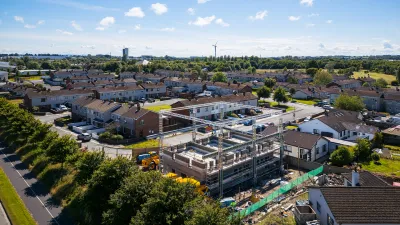
See how HTL.tech deployed one of the most innovative forms of Modern Methods of Construction, 3D concrete printing, for the Grange Close housing development in Dundalk, Co. Louth.
Project details
The first ever 3D-printed housing development in the Republic of Ireland showed the potential for using ready-mix printable concrete to deliver projects at speed with less time onsite.

KEY STATISTICS
What if you could build a house, from foundations to a complete superstructure, in just a few weeks? It would be a boon for the construction industry, giving contractors and developers the opportunity to deliver major new developments to communities across the country. 3D concrete printing may prove to be this vital technology.
In Grange Close near Dundalk Co. Louth, Harcourt Technologies (HTL.tech) has delivered the first 3D-printed housing development in the Republic of Ireland. The superstructure of each house was completed in 18 days of printing, and the entire project was delivered 35% faster than using traditional construction methods. Jandré Oosthuizen, Director of 3DCP Operations & Materials explained how this project utilised elements of traditional and additive construction:
“All three of the dwellings were, constructed at the same time ... by building up the structure or components in layers. We followed Eurocode 6 for the structure. So, it’s essentially a masonry building designed as masonry, but we utilise ready mixed concrete for the structural material. And then we build it by 100mm-wide concrete leaves by 50mm-high, layer by layer ... so, a traditional construction methodology, just utilising a digital technology.”
Director of 3DCP Operations & Materials, HTL
After the contractor poured the foundations, HTL.tech brought the construction printer to the site and printed concrete material atop layer after layer using a gantry printing system. This process also only required three or four expert operatives onsite to operate the 3D printer and quality-check the concrete mixture and finish of the structure. Again, technology makes the use of a traditional construction material more efficient.
Speed wasn’t the only benefit, either – Auveen O'Donnell, BIM Coordinator at HTL.tech, added that the risk of human error was greatly reduced on the Grange Close development thanks to the advent of 3D concrete printing:
“The superstructure process was 60% faster than when using traditional masonry, but the construction program, as a whole, was also reduced by 35%. And this is as a result of the digital model accuracy ... In traditional construction, you would have each subcontractor coming to site to take measurements, fabricating the elements required off-site, then returning to site to install them ... With direct BIM-to-site transfer, each of the construction elements ... can be fabricated in advance based on the BIM model.”
BIM Coordinator at HTL.tech
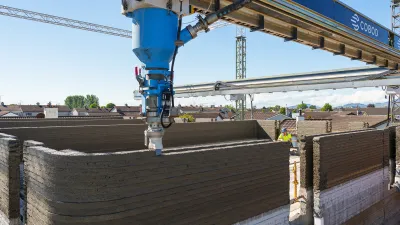
3D construction printing is one of the sector's most dynamic working opportunities, with major possibilities for continuous learning. Although still an emerging way of building, anyone involved in 3D printing for construction will learn elements of Building Information Modelling (BIM), robotics operation, and off-site manufacturing.
Justin Kinsella, Managing Director & Co-Founder at HTL.tech, noted that this technology has appeal for more experienced construction professionals looking for a less manually intensive role:
"They have amazing real-world experience ... but their bodies have been under the strain of working for years. They can't continue on a construction site ... They can be involved where we get to retain their knowledge ... and they oversee the automated construction of the superstructure ... You can work for another 20, 30 years because manual labour is out of the equation.”
Managing Director & Co-Founder at HTL.tech
3D concrete printing can also suit younger people trying to start out in construction:
“The time it takes to become a trained operative is probably 10% of what it would be to become a skilled craftsman as an alternative. So, it's a very quick route to getting involved, making a meaningful contribution.”
Managing Director & Co-Founder at HTL.tech
Vasyl Pylypiv, 3DCP Print Operator for HTL.tech, can speak to the ease of training in this seemingly complex equipment and building new skills pathways:
“It was by chance [I became a 3DCP Print Operator] – I came to Ireland because of the war in Ukraine ... When I joined, I did 10 weeks of intensive training. ... I learned to operate a COBOD 3D printer, concrete pump, and batch plant, and I also completed COBOD Level One and Two certification. Now, I'm doing my final level to become a certified trainer.”
3DCP Print Operator for HTL.tech
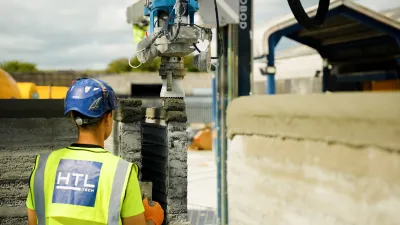
Auveen was also previously unaware of the benefits of 3D construction printing. After completing a Bachelor of Architecture at TU Dublin, she wanted to build her working knowledge of the digital technologies used in Modern Methods of Construction:
“Additive construction is the only methodology that allows for the direct transfer of the digital model to site ... Now, with BIM being incorporated legally into all the public works contracts, it’s kind of unavoidable it’s going to be how we'll develop ... So, BIM is becoming a requirement across all forms of construction projects, but it is an inherent necessity of additive construction.”
BIM Coordinator at HTL.tech
HTL.tech, as the only 3D print operators in the Republic of Ireland, offer a range of education opportunities in this emerging technology. Mary Glennon, HTL.tech’s Director of Training and Education, is responsible for developing and overseeing the training that staff and outside contractors needed to make Grange Close happen.
“Before the guys were ready to go onsite, we ensured everybody was trained on COBOD Level One and Two on the actual printer and materials ... They had completed a 10-week intensive course on preparing to print the house.”
HTL.tech’s Director of Training and Education
Beyond their own projects, Mary and HTL.tech also offer training to construction professionals across Ireland, onsite at their R&D facility in Drogheda and in the Advanced Manufacturing Training Centre of Excellence in Dundalk, Co. Louth.
“We do a two-day Fundamentals of 3D Construction Printing course. One day is the science, the technology, the business cases. The second day is at HTL.tech for a live print ... we have block layers coming in and saying, ‘I would have dismissed this before, but it’s the way to go’. That's why we're trying to get out with these small courses, to show them [what’s possible]”.
HTL.tech’s Director of Training and Education
The flexibility and speed of build possible with 3D construction printing means, as Justin put it, “the sky’s the limit” for this emerging additive construction technology.
Do YOU have a case study you want featured on the site?
Click the button below to find out more about getting one of your own MMC projects featured on this website.
Get in touch now